Bathroom Mirror Size for Your Vanity
Enter your vanity width and pick a width rule to get the mirror width, height and how high above the counter the bottom edge goes.
Recent
Your last 10 settings, saved only in this browser. Nothing is uploaded.
How to use the bathroom mirror size calculator
- Enter the vanity width as a number. Choose inches or centimeters. Widths from 18 to 120 in are accepted, and anything outside that range shows a warning.
- Choose one or two sinks.
- If you chose two sinks, pick either one wide mirror across the whole vanity or one mirror per sink.
- Choose the width rule you want to follow. Rule A leaves 2 to 4 in of space on each side of the mirror. Rule B sets the mirror at 70 to 90 percent of the vanity width.
- Optionally, open the advanced setting and enter the countertop height from the floor. The default is 36 in. Countertop heights outside 24 to 48 in show a warning.
- Read the results: the mirror width, the mirror height, and the bottom-edge position above the floor.
- Check for errors. Blank, non-numeric, zero, or negative values are flagged. If the vanity is too narrow for Rule A, the mirror width would be zero or less, so the tool shows an error instead of a size.
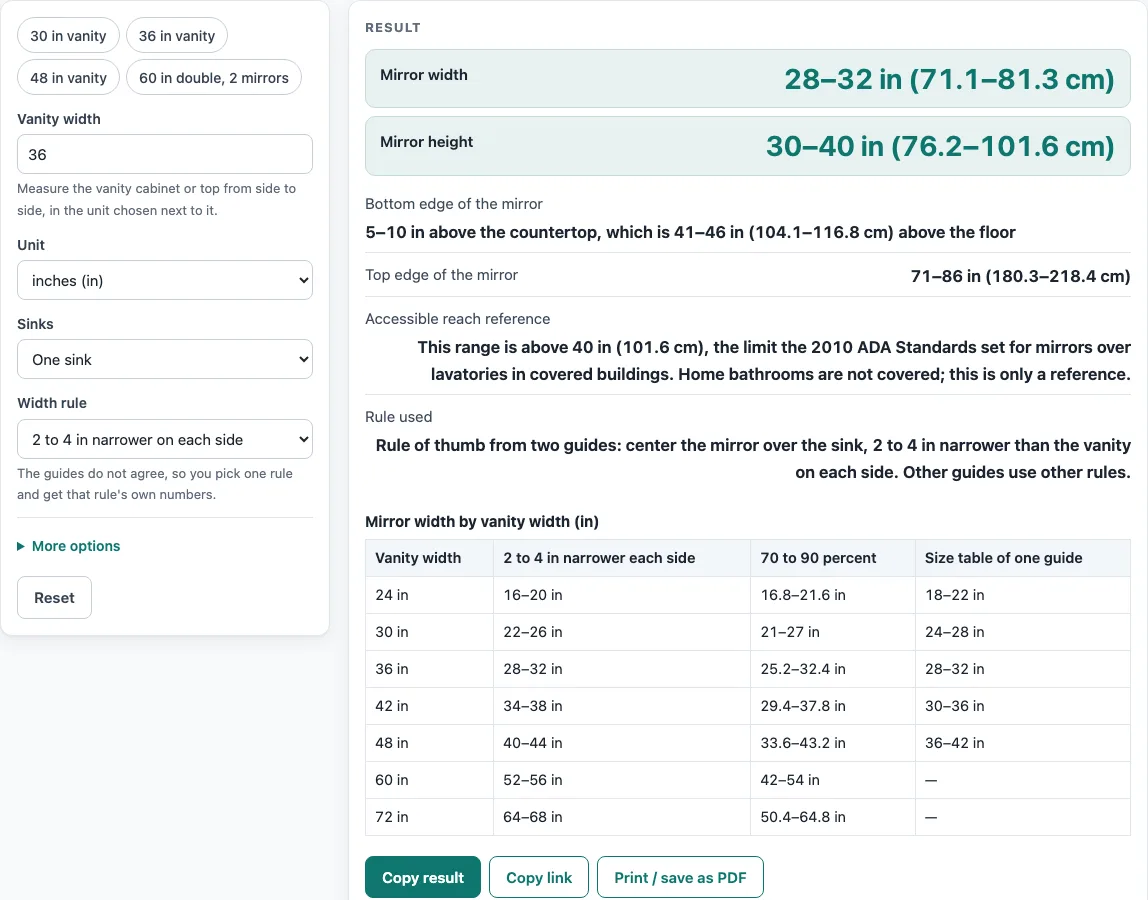
Each rule gives its own numbers, and the tool never mixes them. For a 36 in vanity, Rule A gives a mirror 28 to 32 in wide, and a 48 in vanity under Rule B gives 33.6 to 43.2 in. To compare options, change only the rule and read each set of results separately.
How wide should a bathroom mirror be over a vanity?
Two rules cover most of the approaches the tool uses. Rule A centers the mirror and leaves 2 to 4 in of space on each side, so the mirror width is the vanity width minus 8 in up to the vanity width minus 4 in. A 36 in vanity gives a mirror of 28 to 32 in (71.1 to 81.3 cm).
Rule B sets the mirror at 70 to 90 percent of the vanity width. A 48 in vanity gives 33.6 to 43.2 in. The same guide includes a table that matches common vanity widths: 24 in gives 18 to 22 in, 30 in gives 24 to 28 in, 36 in gives 28 to 32 in, 42 in gives 30 to 36 in, and 48 in gives 36 to 42 in. The tool shows this table only when your vanity width matches a row. One source’s written text gives 2 to 6 in of side space, but its own table matches 2 to 4 in, so the table and the percentage range are used here.
A double vanity needs a separate calculation. With one mirror per sink, the rule is applied to half the vanity width. A 60 in vanity has a 30 in zone for each sink, so Rule A gives 22 to 26 in for each mirror. With one wide mirror, the whole width is used, so the same vanity gives 52 to 56 in. The tool also shows a chart of mirror widths for vanity widths of 24, 30, 36, 42, 48, 60, and 72 in under each rule.
How tall should a bathroom mirror be, and where should its bottom edge sit?
One guide says a mirror height of 30 to 40 in works in most bathrooms. For placement, two guides put the bottom edge 5 to 10 in above the countertop. A third says a few inches above the tallest point of the faucet, and another measures from the faucet. The tool uses only the countertop measurement, so the bottom edge is the countertop height plus 5 to 10 in.
For a 36 in countertop, the bottom edge sits 41 to 46 in above the floor. Adding the mirror height gives a top edge of 71 to 86 in. Those figures are calculated from your inputs, so your result depends on the countertop height you enter.
The 2010 ADA Standards limit the bottom edge of a mirror over a lavatory to 40 in above the floor in covered buildings. Home bathrooms are not covered by those standards. The tool does not judge your bathroom against that limit. It shows only whether your bottom-edge range falls below 40 in, partly above it, or entirely above it, so you can see where your layout sits relative to that reference.
Sizes vary by manufacturer. Use the results as a planning range, then compare them with the dimensions of the mirror you are considering.
Sources (checked 15 October 2026): infinite-bath.com · wayfair.com · edwardmartin.com · hunker.com · ada.gov
Worked examples
| Input | Result |
|---|---|
| 36 in vanity, 1 sink(s), rule A | mirror width 28–32 in (71.1–81.3 cm) |
| 48 in vanity, 1 sink(s), rule B | mirror width 33.6–43.2 in (85.3–109.7 cm) |
| 60 in vanity, 2 sink(s), rule A | mirror width 22–26 in (55.9–66 cm) |
| 72 in vanity, 2 sink(s), rule B | mirror width 50.4–64.8 in (128–164.6 cm) |
| 91 cm vanity, 1 sink(s), rule A | mirror width 27.8–31.8 in (70.7–80.8 cm) |
Calculated by the tool above; open it with the same values to see each step.
Frequently asked questions
What is the standard bathroom mirror size?
No single size is fixed for every bathroom. The tool calculates a width from your vanity, and typical sizes depend on the rule you pick and the maker of the mirror.
Should a bathroom mirror be the same width as the vanity?
Usually it is narrower. Rule A leaves 2 to 4 in of space on each side of the mirror, and Rule B sets the mirror at 70 to 90 percent of the vanity width.
How high should a bathroom mirror hang?
One guide says a height of 30 to 40 in works in most bathrooms. The bottom edge usually sits 5 to 10 in above the countertop, so the bottom edge height depends on your countertop.
How far above the sink should the bottom of a mirror be?
Two guides place the bottom edge 5 to 10 in above the countertop. Other guides measure from the faucet instead, so the tool uses the countertop as its reference point.
Can one mirror cover a double vanity?
Yes. With one wide mirror, the tool uses the full vanity width, so a 60 in vanity gives 52 to 56 in. If you want one mirror for each sink, the rule is applied to half the width instead.
Why do different guides give different numbers?
Guides use different rules of thumb, and some measure from different points. The tool shows one rule at a time so each set of numbers stays consistent.
Related tools
- Picture Hanging Height Calculator: use it to set the height of wall art and other frames above a surface.
- Standard Sofa Dimensions: use it to check sofa sizes before you plan a living room layout.
- TV Stand Size Calculator: use it to find a stand width that suits your television.
- Wall Art Size Guide: use it to choose the right size of artwork for a wall.