Bed Height Calculator
Enter your frame, foundation, mattress and topper to see the height of the top of the mattress, how it compares with typical beds, and the frame that reaches your target.
Recent
Your last 10 settings, saved only in this browser. Nothing is uploaded.
This bed height calculator adds up the parts of a bed (frame, foundation, mattress and topper) to show the height from the floor to the top of the mattress. It then compares that number with the heights that mattress sellers, mattress makers and a furniture maker call typical, and shows the frame height you would need to reach a target. The tool runs in your browser, is free, and needs no sign-up.
Use it when you are buying a new bed, checking a frame you already own, or planning a change such as adding a riser or a topper. Bed heights vary between brands, so read the results as a guide to what suits your body and room, not as a fixed rule.
How to use the Bed Height Calculator
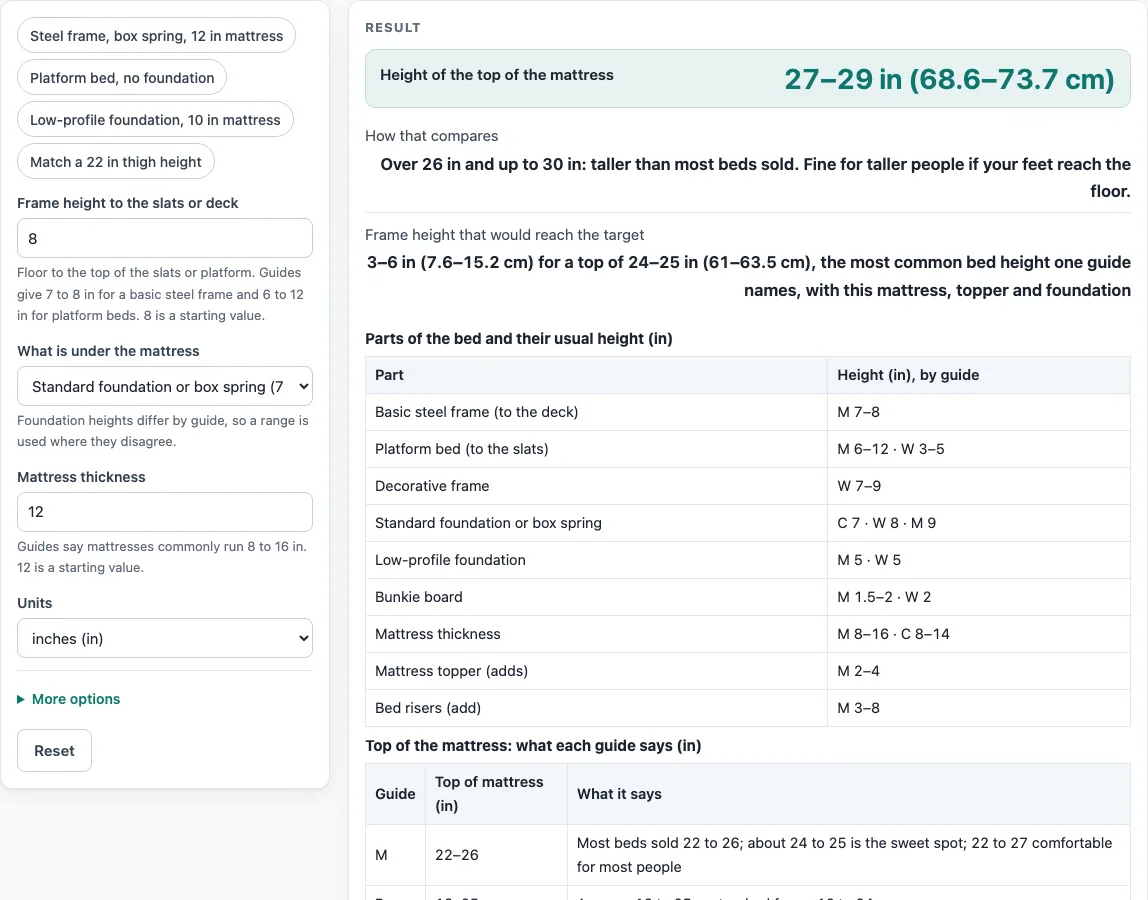
- Enter the frame height to the slats or deck. The starting value is 8 in.
- Choose what is under the mattress: “Nothing (mattress on the slats or platform)”, “Bunkie board (1.5 to 2 in)”, “Low-profile foundation (5 in)” or “Standard foundation or box spring (7 to 9 in)”. The starting choice is the standard foundation.
- Enter the “Mattress thickness”. The starting value is 12 in.
- Pick your “Units”.
- Open “More options” and enter the “Mattress topper thickness”. The starting value is 0.
- Optionally, enter “Your seated thigh height (optional)” in the same section. Measure it with the knee test described below.
- Read the three results: “Height of the top of the mattress”, “How that compares” and “Frame height that would reach the target”.
- Scroll to the two charts. The first lists the parts of a bed and their usual heights. The second shows the top-of-mattress heights each guide gives, marked with the letters M, P, N, C and W.
If you want a quick start, use a preset button: “Steel frame, box spring, 12 in mattress”, “Platform bed, no foundation”, “Low-profile foundation, 10 in mattress” or “Match a 22 in thigh height”. Each preset fills in the controls, and you can change any value afterward.
What is the standard height of a bed?
There is no single standard. Most guides put the top of the mattress between about 22 and 26 in, and about 25 in is a figure several of them repeat.
The guides in the chart differ. One mattress retailer says most beds sold today measure 22 to 26 in, with 24 to 25 in the most common. A mattress maker, Casper, says the standard is about 25 in. Nolah gives an average of about 18 to 25 in, with a box spring and coil mattress at about 25 in. Puffy gives 16 to 25 in, and the furniture maker Millwest says ergonomics experts suggest 20 to 24 in.
What is a comfortable bed height?
For most adults, a comfortable top of the mattress falls between about 22 and 27 in. The retailer’s guide suggests the knee test to find your own number: sit on a firm chair with your knees at 90 degrees, and measure from the floor to the top of your thigh. Match that number as the top of the mattress. Tall people usually need more height than short people, so use your own measurement rather than a general range.
The tool uses these bands. Under 20 in feels low for anyone with knee or hip trouble. 22 to 26 in covers most beds sold. Above 30 in usually means climbing into bed. It also names 20 to 22 in (lower than most beds sold) and 26 to 30 in (taller than most).
How do I make a bed higher?
Change the parts that sit between the floor and the mattress. Bed risers add roughly 3 to 8 in. Swapping a low-profile foundation for a standard one adds about 4 in. A mattress topper adds 2 to 4 in. A thicker mattress also raises the top, which the tool shows when you change the mattress thickness.
To lower a bed, reverse these changes. Swapping a standard foundation for a low-profile one drops the bed about 4 in, and a bunkie board in place of a foundation drops it 7 in or more.
How high should a bed be for an elderly person?
For older people or anyone with limited mobility, the retailer’s guide gives 20 to 25 in for the top of the mattress. Check that the feet rest solidly on the floor when seated on the edge of the bed, and that the hips sit level with or slightly above the knees. Sitting a little higher than the knees makes standing up easier. For a child, a mattress maker says lower is better.
How do I measure my bed height?
Measure from the floor to the top of the mattress, not to the top of the frame rail. If you are checking a bed you already own, you can also add up the parts. Total = frame + foundation + mattress + topper. With the starting values, 8 in + 7 to 9 in + 12 in gives 27 to 29 in. With a low-profile foundation of 5 in, the total is 25 in.
To find the frame you need for a target, subtract the other parts: Frame height needed = target − mattress − topper − foundation. With no thigh height entered, the tool aims at 24 to 25 in. With the starting values, that is 24 − 12 − 9 = 3 in and 25 − 12 − 7 = 6 in. A 24 in thigh height gives 3 to 5 in.
Sources (checked 23 October 2026): mattressstoreslosangeles.com · puffy.com · nolahsleep.com · casper.com · millwest.com
Worked examples
| Input | Result |
|---|---|
| 8 in frame, Standard foundation or box spring (7 to 9 in), 12 in mattress | top of mattress 27–29 in (68.6–73.7 cm) |
| 8 in frame, Low-profile foundation (5 in), 12 in mattress | top of mattress 25 in (63.5 cm) |
| 10 in frame, Nothing (mattress on the slats or platform), 10 in mattress | top of mattress 20 in (50.8 cm) |
| 7.9 in frame, Bunkie board (1.5 to 2 in), 11.8 in mattress | top of mattress 23.2–23.7 in (58.8–60.1 cm) |
| 14 in frame, Standard foundation or box spring (7 to 9 in), 14 in mattress | top of mattress 38–40 in (96.5–101.6 cm) |
Calculated by the tool above; open it with the same values to see each step.
Frequently asked questions
Why does the tool show a range instead of one number?
Foundation heights differ by guide. Casper lists 7 in, Millwest 8 in and Mattress Stores Los Angeles 9 in for a standard foundation. The tool shows the full range rather than averaging these values.
What does “no frame is needed” mean?
It means the mattress, topper and foundation already reach your target height. The tool then suggests a thinner mattress, a low-profile foundation or a bunkie board to bring the total down.
Why does the tool show a warning?
Warnings appear when a value is outside the expected range: a mattress outside 4 to 20 in, a frame over 30 in, or a thigh height outside 12 to 36 in. Check the number you entered, since a warning usually points to a typing error or an unusual measurement.
Is 30 inches too high for a bed?
It depends on your height. One mattress maker says the average is about 25 in and that around 30 in can suit taller people but may be too high if you are below average height. The retailer’s guide says a bed above 30 in usually means climbing into it.
Can I use centimeters?
Yes. Set “Units” to centimeters before you type your frame height, mattress thickness, topper and thigh height. The results show both inches and centimeters.
Does the tool keep my measurements?
Nothing is uploaded. The calculator runs in your browser, so your numbers stay on your device.
Related tools
- Nightstand Height: Use it to match a nightstand’s top to the height of your mattress.
- Bench Height and Size Calculator: Use it to size a bench for the foot of your bed.
- Dresser Dimensions and Fit Calculator: Use it to check that a dresser fits the space beside or across from your bed.
- Rug Size for a Queen Bed: Use it to find a rug size that fits around a queen bed.
- Dining Chair Height for Your Table: Use it to pick chairs that suit your dining table’s height.
- Tables and Seat Heights: Use it to compare typical heights for tables and seats in one place.