Bedroom Area Rug Size
Choose the bed, enter the room size and the bare floor you want to the walls. You get the standard rug sizes that cover the bed and still fit the room.
Recent
Your last 10 settings, saved only in this browser. Nothing is uploaded.
How to use the Bedroom Area Rug Size Calculator
- Choose a “Bed size”: “King (76 × 80 in)”, “Queen (60 × 80 in)” or “Other size”. For “Other size”, enter the “Bed width” and “Bed length”.
- Enter the “Room width (headboard wall)”, measured along the wall behind the headboard.
- Enter the “Room length (head to foot)”, measured from the head of the bed to the foot.
- Pick the unit for your measurements: in, ft, cm or m.
- Choose “Rug placement”: “Under the whole bed” or “Under the lower two-thirds”.
- Open “More options” and check “Bare floor to the walls” (starts at 18 in).
- Check “Rug beyond each side” (starts at 18 in) and “Rug past the foot” (starts at 24 in). Change them if your guide gives other numbers.
- Tick or clear “Head of the bed is against a wall”.
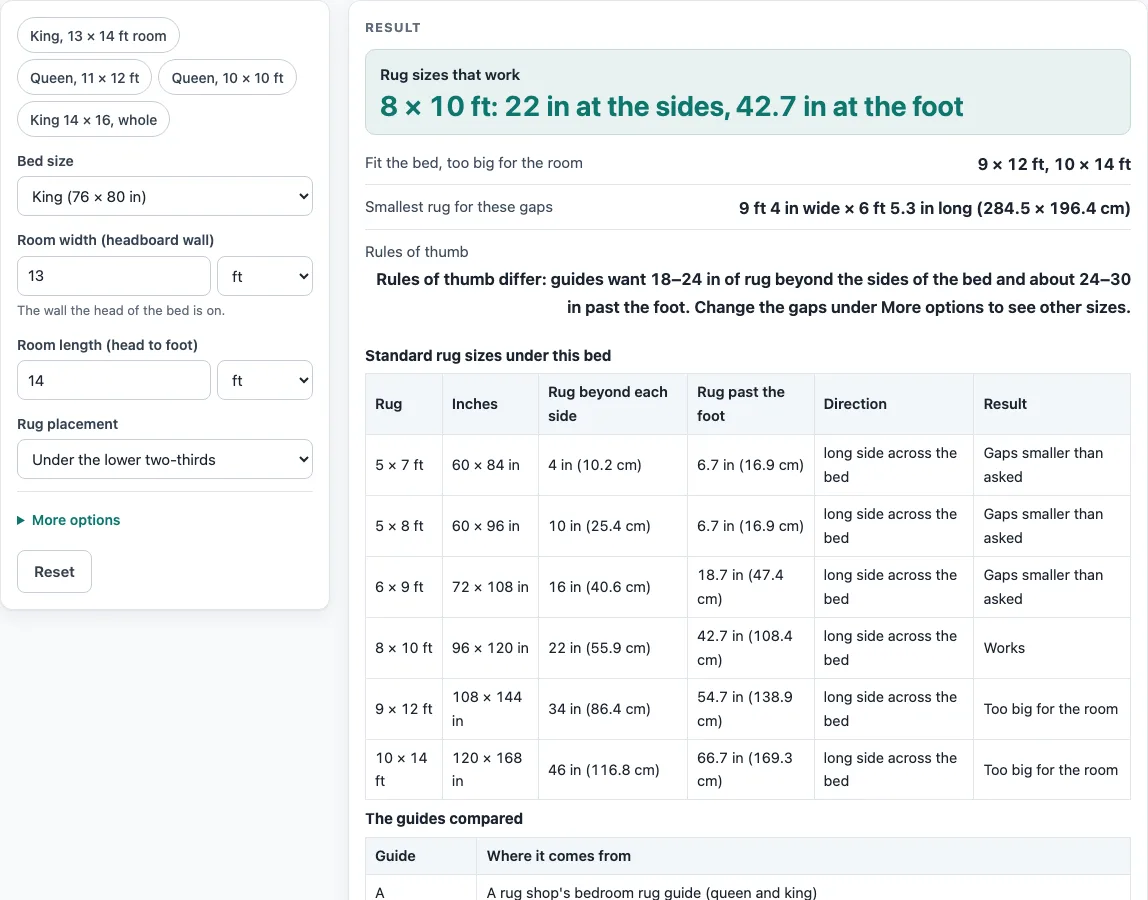
- Read the table. Each row gives a rug size, the inches beyond each side, the inches past the foot, the direction used, and a “Result”. Look for “Works”. Above the table, “Rug sizes that work”, “Fit the bed, too big for the room” and “Smallest rug for these gaps” sum it up.
The tool tests 5 x 7, 5 x 8, 6 x 9, 8 x 10, 9 x 12 and 10 x 14 ft. It shows warnings when the bed is bigger than the room, a side gap is under 18 in, the bed size is unusual, or no standard size gives your gaps and fits the room. Everything is calculated in your browser, and nothing is uploaded.
How does the bed check set the smallest rug size?
The bed check finds the least rug that gives your gaps. The rug width needed is the bed width plus two times the side gap. The rug length needed is the bed length, or two-thirds of it when you choose “Lower two-thirds”, plus the foot gap. If the bed is not against a wall, the side gap is added at the head end too.
How does the room check limit the rug size?
The room check finds the largest rug that still leaves bare floor. The rug can be at most the room width minus two times the bare floor across. Along the room, it can be at most the room length minus the bare floor. The head end may run to the wall behind the bed. If the bed is not against a wall, the bare floor is kept at the head end too.
What do the results mean?
“Works” means the rug gives the gaps you set and fits the room. “Too big for the room” means the rug gives the gaps but is too big for the room. “Gaps smaller than asked” means the rug fits the room, but the space beside or past the bed is less than you set.
Why do the gap numbers differ between guides?
Guides do not agree on the gap beside the bed. Some give 18 to 24 in or more, others at least 18 in, and one gives 24 to 30 in with 18 in as the minimum. For the gap past the foot, guides give about 24 in or 24 to 30 in. For wall clearance in a bedroom, one guide gives 18 to 24 in, while others give 12 in or more for other rooms. The page starts at 18 in beside the bed and 24 in past the foot, and you can change both.
Bed sizes also vary. Mattress widths can differ by about an inch between makers, and a frame or headboard is wider than the mattress. One guide gives 84 in in one place and 96 in in its FAQ as the minimum width for a queen bed rug. Measure the bed you own rather than relying on a typical size.
Sources (checked 15 October 2026): atlantadesignerrugs.com · tumbleliving.com · chairish.com · bassettfurniture.com · amerisleep.com · atlantadesignerrugs.com
Worked examples
| Input | Result |
|---|---|
| king: 76 × 80 in bed, 18 in at the sides, 24 in at the foot, Under the lower two-thirds | works: 8 × 10 ft |
| queen: 60 × 80 in bed, 18 in at the sides, 24 in at the foot, Under the lower two-thirds | works: 8 × 10 ft |
| king: 76 × 80 in bed, 18 in at the sides, 24 in at the foot, Under the whole bed | works: 10 × 14 ft |
| king: 76 × 80 in bed, 18 in at the sides, 24 in at the foot, Under the lower two-thirds | works: 8 × 10 ft |
Calculated by the tool above; open it with the same values to see each step.
Frequently asked questions
Which bed sizes can I choose?
You can choose “King (76 × 80 in)”, “Queen (60 × 80 in)” or “Other size”, where you type your own bed width and length.
What does “Too big for the room” mean?
The rug is wide enough and long enough to give your gaps around the bed, but it is too big for the room once the bare floor to the walls is kept.
Why does a side gap under 18 in trigger a warning?
The starting setting is 18 in, and some guides give 18 in or more beside a bed. A gap under 18 in is flagged so you can check it against your guide.
Can I enter measurements in cm or m?
Yes. Pick cm or m as the unit for your measurements.
Does the tool upload my measurements?
No. Everything is calculated in your browser, and nothing is uploaded.
Does a result of “Works” mean the rug is safe or meets code?
No. A “Works” result is calculated from the gaps and room size you entered. It is not a safety or code check, and sizes vary by maker.
Which rug sizes does the tool check?
It tests 5 x 7, 5 x 8, 6 x 9, 8 x 10, 9 x 12 and 10 x 14 ft. The table shows the inches of rug beyond each side, past the foot and the direction the rug lies. Each row says whether the size works for the gaps and the room you entered.
Related tools
- Living Room Rug Size: Use this when the rug goes in a living room rather than a bedroom.
- Rug Size Chart: Use this to compare common rug sizes side by side.
- Rug Size for a Dining Table: Use this when the rug sits under a dining table and chairs.
- Rug Size for a King Bed: Use this for a closer look at rugs sized for a king bed.
- Rug Size for a Queen Bed: Use this for a closer look at rugs sized for a queen bed.