Bunk Bed Dimensions and Ceiling Fit
Choose a bunk or loft bed and enter your ceiling, mattress and guardrail height to see its size, the guardrail margin and the space left under your ceiling.
Recent
Your last 10 settings, saved only in this browser. Nothing is uploaded.
This free bunk bed dimensions tool shows the mattress sizes, overall height and floor space of five bunk and loft bed types. It also checks whether your top mattress keeps the legal guardrail margin and how much room is left under your ceiling. It runs in your browser, needs no sign-up, and does not upload anything you enter.
Choose a bed type, then enter your ceiling height, top mattress thickness and guardrail height, and the results update on the page. The five types are twin over twin, twin over full, full over full, twin XL over twin XL, and a twin loft bed, which is the loft bed option with open space below. The sizes are typical figures, so use the results for planning and confirm the details in your bed’s manual before you buy a mattress.
How to use the Bunk Bed Dimensions Tool
- Open the Bunk bed list and choose a type: Twin over twin, Twin over full, Full over full, Twin XL over twin XL, or Twin loft bed (open space below).
- Enter your Ceiling height in inches.
- Enter your Top mattress thickness in inches.
- Enter your Guardrail height above the top bunk slats. Read this number in your bed’s manual, because the tool cannot know your bed’s real guardrail height.
- If you want centimeters, open More options and set Units to centimeters.
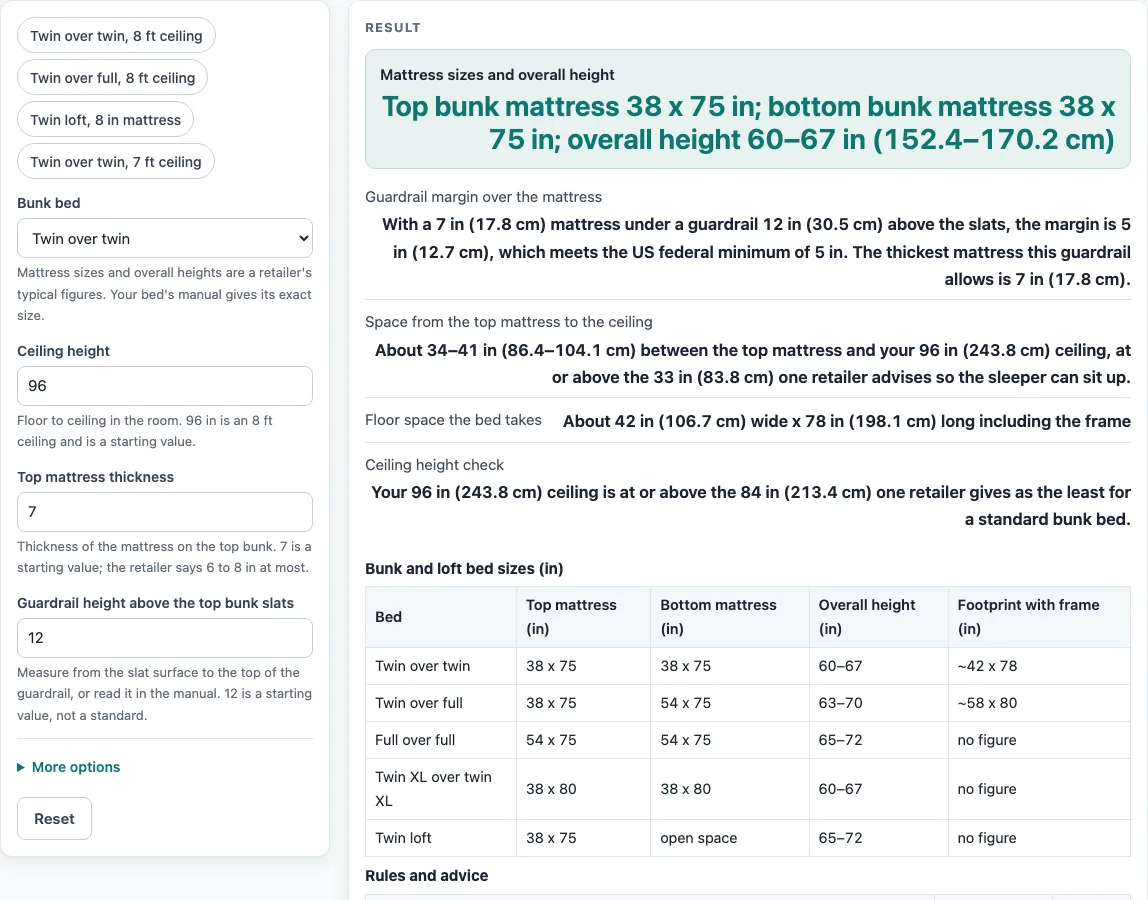
- Read the five results: Mattress sizes and overall height, Guardrail margin over the mattress, Space from the top mattress to the ceiling, Floor space the bed takes, and Ceiling height check.
- Scroll down to the two charts, bunk and loft bed sizes and rules and advice, to compare types. The letters R, M and D in the legend mark the sources.
The four preset buttons fill in common setups: Twin over twin with an 8 ft ceiling, Twin over full with an 8 ft ceiling, Twin loft with an 8 in mattress, and Twin over twin with a 7 ft ceiling. The starting values are twin over twin, a 96 in ceiling, a 7 in mattress and a 12 in guardrail. These are examples, not standards. An empty, zero or non-numeric value shows an error. A ceiling outside 72 to 144 in, a guardrail outside 8 to 20 in, or a mattress outside 3 to 14 in shows a warning.
How thick can the top bunk mattress be?
The thickest top mattress is the guardrail height above the slats minus 5 inches. The US Consumer Product Safety Commission standard (16 CFR Part 1213, and Part 1513 for children’s bunk beds) requires the upper edge of the guardrails to be at least 5 in (130 mm) above the top surface of the mattress. That mattress is the thickest one the bed maker specifies. The upper bunk’s end structures must also stay at least 5 in above the mattress for at least half the distance between the posts.
So the formula is: maximum mattress thickness = guardrail height above the slats − 5 in. With the starting 12 in guardrail, the thickest mattress is 7 in. A retailer’s guide advises a top bunk mattress of 6 to 8 in at most. That advice is not part of the CPSC text, so treat it as a separate suggestion.
What ceiling height do you need for a bunk bed?
A standard bunk bed needs at least 84 in of ceiling, according to the retailer’s guide. The sleeper also needs at least 33 in between the top mattress and the ceiling so they can sit up. The tool calculates that second figure from your inputs.
The tool treats the top of the guardrail as the top of the bed, so it works out the height like this:
- Top of mattress = overall height − guardrail height + mattress thickness
- Space to ceiling = ceiling height − top of mattress
Take a twin over twin bed, which is 60 to 67 in tall, with a 12 in guardrail, a 7 in mattress and a 96 in ceiling. The top of the mattress is 55 to 62 in (60 − 12 + 7 and 67 − 12 + 7). That leaves 34 to 41 in of space to the ceiling, which meets the 33 in advice.
Now take a twin over full bed, which is 63 to 70 in tall, with an 8 in mattress, a 12 in guardrail and a 90 in ceiling. The top of the mattress is 59 to 66 in. That leaves only 24 to 31 in to the ceiling, below the 33 in advice. The 8 in mattress also leaves a 4 in margin under the guardrail, which is below the 5 in rule, so the thickest allowed is 7 in.
Sources (checked 23 October 2026): US CPSC, 16 CFR Part 1213 (eCFR) · mattressmiracle.ca, bunk bed measurements · dimensions.com, Doshie twin over twin
Worked examples
| Input | Result |
|---|---|
| Twin over twin, 96 in ceiling, 7 in mattress | thickest mattress 7 in, 34 to 41 in to the ceiling |
| Twin over full, 90 in ceiling, 7 in mattress | thickest mattress 7 in, 25 to 32 in to the ceiling |
| Twin loft, 96 in ceiling, 9 in mattress | thickest mattress 7 in, 27 to 34 in to the ceiling |
| Full over full, 84 in ceiling, 8 in mattress | thickest mattress 8 in, 17 to 24 in to the ceiling |
| Twin XL over twin XL, 96.1 in ceiling, 6.7 in mattress | thickest mattress 6.8 in, 34.2 to 41.2 in to the ceiling |
Calculated by the tool above; open it with the same values to see each step.
Frequently asked questions
How tall is a bunk bed?
Typical overall heights are 60 to 67 in for twin over twin and twin XL over twin XL, 63 to 70 in for twin over full, and 65 to 72 in for full over full and for a twin loft bed. The retailer’s guide gives these ranges. The frame is larger than the mattress, so measure the inside of your own frame.
How much space does a bunk bed take up?
A twin-over-twin bed takes roughly 42 x 78 in including the frame, and a twin-over-full bed about 58 x 80 in. The guide says to allow 30 in on the ladder side. The tool gives no footprint for the other types because the guide does not list one. A single twin-over-twin product on Dimensions.com measures 63 in high, 41.5 in wide and 77.5 in long, so check your own model.
What is the difference between a bunk bed and a loft bed?
A bunk bed has two beds stacked, with a sleeper on the top bunk and another underneath. A loft bed has one sleeping platform raised over open floor space, so there is no bottom mattress. Both follow the same guardrail rule when the sleeping platform is more than 30 in from the floor.
Does the tool know my bed’s guardrail height?
No. Find the guardrail height in your bed’s manual and enter it in the guardrail field. The 12 in starting value is only an example.
Are these sizes standard?
No. They are typical sizes, and each maker’s bed differs. Check the manual for the exact size, the guardrail height and the thickest mattress the bed allows.
Related tools
- Coffee Table Dimensions by Shape, Room and Sofa: Use it to find a table size that fits your seating and room.
- Dresser Dimensions and Fit Calculator: Use it to check whether a dresser fits in your bedroom.
- Nightstand Height: Use it to match a nightstand’s height to your mattress.
- Rug Size for a Queen Bed: Use it to pick a rug for a queen bed.
- Rug Size for a King Bed: Use it to pick a rug for a king bed.
- Sofa, Wall and Decor Sizes: Use it to size sofas, wall art and decor for a room.