What Size Ceiling Fan for a 12x12 Room?
A 12 × 12 ft room is 144 sq ft, where the guides change size band. See the blade span each lists and change the room or ceiling to compare.
Recent
Your last 10 settings, saved only in this browser. Nothing is uploaded.
How to use the ceiling fan size tool
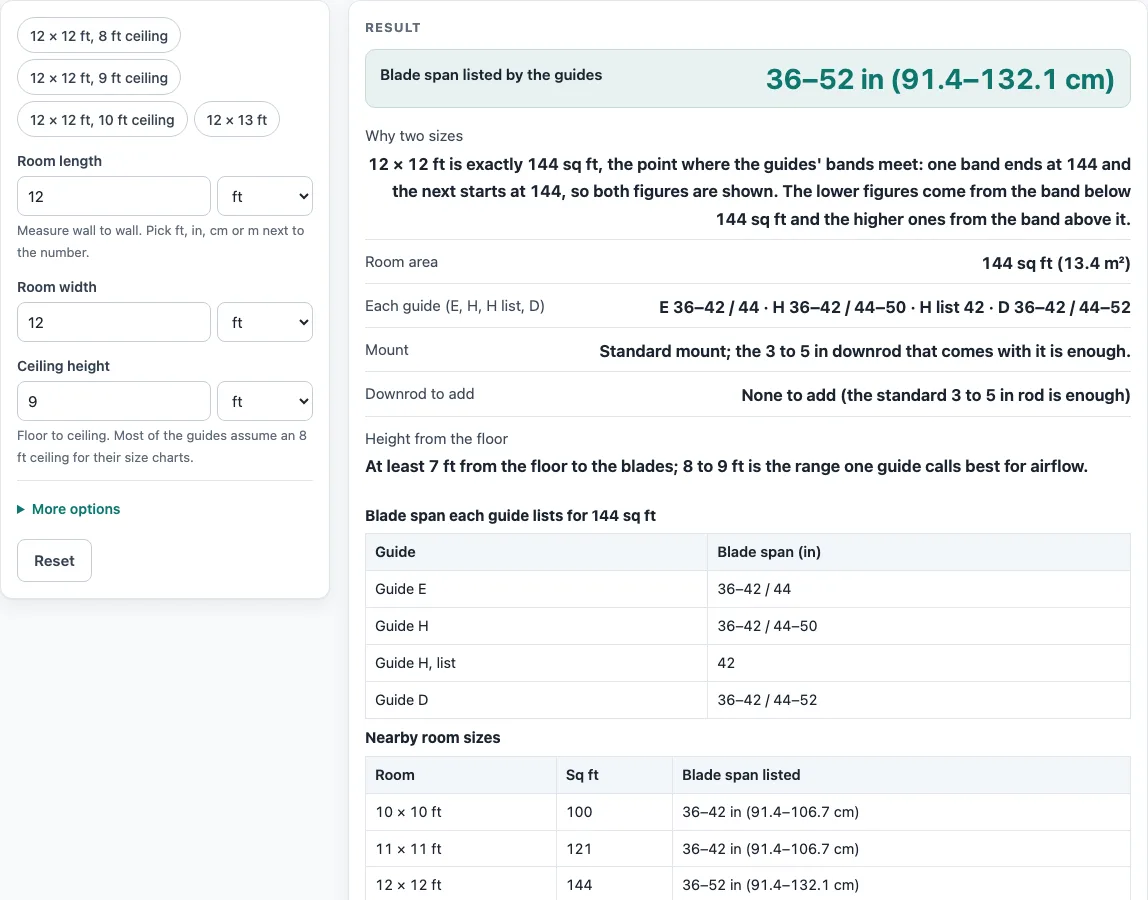
- Look at the default result first. It shows a 12 × 12 ft room with a 9 ft ceiling, which gives a headline range of 36 to 52 in.
- Enter your room length and width. You can type them in ft, in, cm or m.
- Check the area line. The tool shows the area in sq ft and m². For 12 × 12 ft, that is 144 sq ft (13.4 m²).
- Enter your ceiling height.
- Open “More options” if you want to change the fan height or blade height. The defaults are 12 in for fan height and 8 ft for blade height.
- Read the blade span range. It is shown in inches and in cm.
- Read the downrod result. If it is 5 in or less, the standard 3 to 5 in downrod that comes in the box is enough.
- Read any warnings. They cover blades planned below 7 ft, a standard rod that would leave blades under 7 ft, a rod over 120 in or between 5 and 6 in, room or ceiling values outside the expected ranges, areas over 400 sq ft, and exact band edges.
- If your room is close to a band edge, compare it with the nearby rooms table on the page.
The results are calculated from the numbers you enter, so change any input and the outputs update with it.
Why does a 12x12 room show two ceiling fan sizes?
A 12 × 12 ft room is exactly 144 sq ft, and that figure is the shared edge of two area bands. The guides write the bands as 76–144 and 144–225, so 144 sq ft belongs to both. The page shows both sets of figures rather than choosing one. For 144 sq ft, the lower band gives 36–42 in in guides E, H and D, and 42 in in guide H’s second list (labelled H list). The upper band gives 44 in in guide E, 44–50 in in guide H and 44–52 in in guide D.
How is the 36 to 52 inch headline range worked out?
The headline range is the lowest and highest blade span that any guide lists for the area. It is never an average. The range is 36 in (91.4 cm) to 52 in (132.1 cm), using the exact conversion of 1 in = 2.54 cm. Guide H’s own second list also conflicts with its chart. The second list gives 36 in up to 100 sq ft and 42 in up to 200 sq ft. All conflicting figures are shown on the page, and none are averaged.
How is downrod length calculated?
The downrod length is the ceiling height minus the fan height minus the blade height above the floor. This is the formula used by a fan maker. The defaults are 12 in for fan height, which is the maker’s own example, and 8 ft for blade height. With a 9 ft ceiling and these defaults, the calculation is 108 − 12 − 96 = 0 in. The result is 5 in or less, so the page says the standard 3 to 5 in downrod in the box is enough. Another source words the rule as “subtract 8 feet from your ceiling height, then add about 1 foot”. That wording gives a different number, so the tool does not use it.
Blade height matters too. The guides give 7 ft as the lowest blade height and 8 to 9 ft as best for airflow. The tool repeats these figures but does not say that any fan meets a code.
Sources (checked 15 October 2026): energystar.gov · thisoldhouse.com · engineerfix.com · hunterfan.com
Worked examples
| Input | Result |
|---|---|
| Room 12 ft × 12 ft, ceiling 9 ft | blade span 36–52 in (91.4–132.1 cm) |
| Room 12 ft × 13 ft, ceiling 9 ft | blade span 42–52 in (106.7–132.1 cm) |
| Room 12 ft × 12 ft, ceiling 10 ft | blade span 36–52 in (91.4–132.1 cm) |
| Room 3.66 m × 3.66 m, ceiling 2.4 m | blade span 42–52 in (106.7–132.1 cm) |
Calculated by the tool above; open it with the same values to see each step.
How this tool works and where the numbers come from
A 12 x 12 ft room is 144 sq ft, the shared edge of the 76-144 and 144-225 sq ft bands, so the page shows both bands. The headline blade span is the lowest and highest span any listed guide gives, never an average. Downrod length = ceiling height - fan height - blade height above the floor (defaults 12 in and 8 ft).
Sources
- ENERGY STAR (U.S. EPA / DOE). Ceiling Fan Basics (suggested fan size by room area; mounting at least 7 ft above the floor, 3 to 5 in standard downrod)
- Hunter Fan Company. How to Measure a Ceiling Fan (keep blades at least 7 feet above the floor; downrod length)
- This Old House. How To Size a Ceiling Fan (room area to fan diameter chart)
Frequently asked questions
Is 52 inches the only size listed for a 12x12 room?
No. The headline range is 36 to 52 in, and the page does not pick one size from it. The tool lists each guide’s figures side by side (E, H, H list and D), so you can compare them for your own room.
What size fan do I need for a 12x12 room with a 10 ft ceiling?
The blade span range does not depend on ceiling height, so it stays 36 to 52 in. The downrod result does. With a 10 ft ceiling and the defaults (12 in fan height, 8 ft blade height), the tool shows a 12 in (30.5 cm) downrod, then round to the next length the maker sells.
Why does the tool show 42 to 52 in for a 12 × 13 room?
A 12 × 13 ft room is 156 sq ft, which is above the 144 sq ft edge. The worked example for this size shows 42 to 52 in, with guide E giving 44 in, guide H 44–50 in, guide H’s list 42 in and guide D 44–52 in.
Why does the tool give a warning about my downrod?
Warnings appear for a rod over 120 in or a rod between 5 and 6 in. A standard rod that would leave the blades under 7 ft also triggers a warning. Change the fan height or blade height under “More options” to see how the result changes.
When does the tool show a low-profile note?
The low-profile (flush) fan note appears only for ceilings under 8 ft. A 9 ft ceiling, which is the default, does not trigger it.
Does the tool tell me whether a fan is code-compliant?
No. The tool gives typical sizes from the named sources and a downrod result calculated from your inputs. It does not say that any fan meets a code or is safe.
Related tools
- Ceiling Fan Size Guide: Use it for a broader look at blade span by room size.
- Lumens per Square Foot by Room: Use it when you are planning the light in the same room.
- Recessed Lighting Spacing Calculator: Use it if you are adding ceiling lights alongside the fan.
- Chandelier Size Calculator: Use it if you are choosing a light fixture for the room.