Ceiling Fan Size Guide
Enter the room length and width and the ceiling height to see the blade span each guide lists for that area and the downrod you need.
Recent
Your last 10 settings, saved only in this browser. Nothing is uploaded.
How to use the ceiling fan size guide
- Enter the room length and choose the unit: ft, in, cm or m. The default room is 15 × 13 ft.
- Enter the room width in the same way. The area is calculated as length × width and shown in sq ft and m².
- Check the ceiling height. The default is 9 ft. Change it if your ceiling is higher or lower.
- Read “Blade span listed by the guides”. It is the lowest and highest blade span any listed guide gives for your area, shown in inches and cm. It is never an average.
- Compare the four sources in “Each guide”, labelled E, H, H list and D. Each figure is shown separately, so you can see where the guides disagree.
- Open “More options” to set “Height of the fan itself” and “Blade height above the floor”. The defaults are 12 in and 8 ft.
- Read “Downrod to add”. If it is 5 in or less, the standard 3 to 5 in rod in the box is enough. Ceilings under 8 ft get a low-profile fan note.
- Read any warnings. They appear for blades planned below 7 ft, a standard rod that would leave blades under 7 ft, a rod over 120 in or between 5 and 6 in, and areas over 400 sq ft.
To see how the page works, leave the default 15 × 13 ft room and 9 ft ceiling in place first. Then change one value at a time and watch which results move.
How is the blade span range worked out for a room?
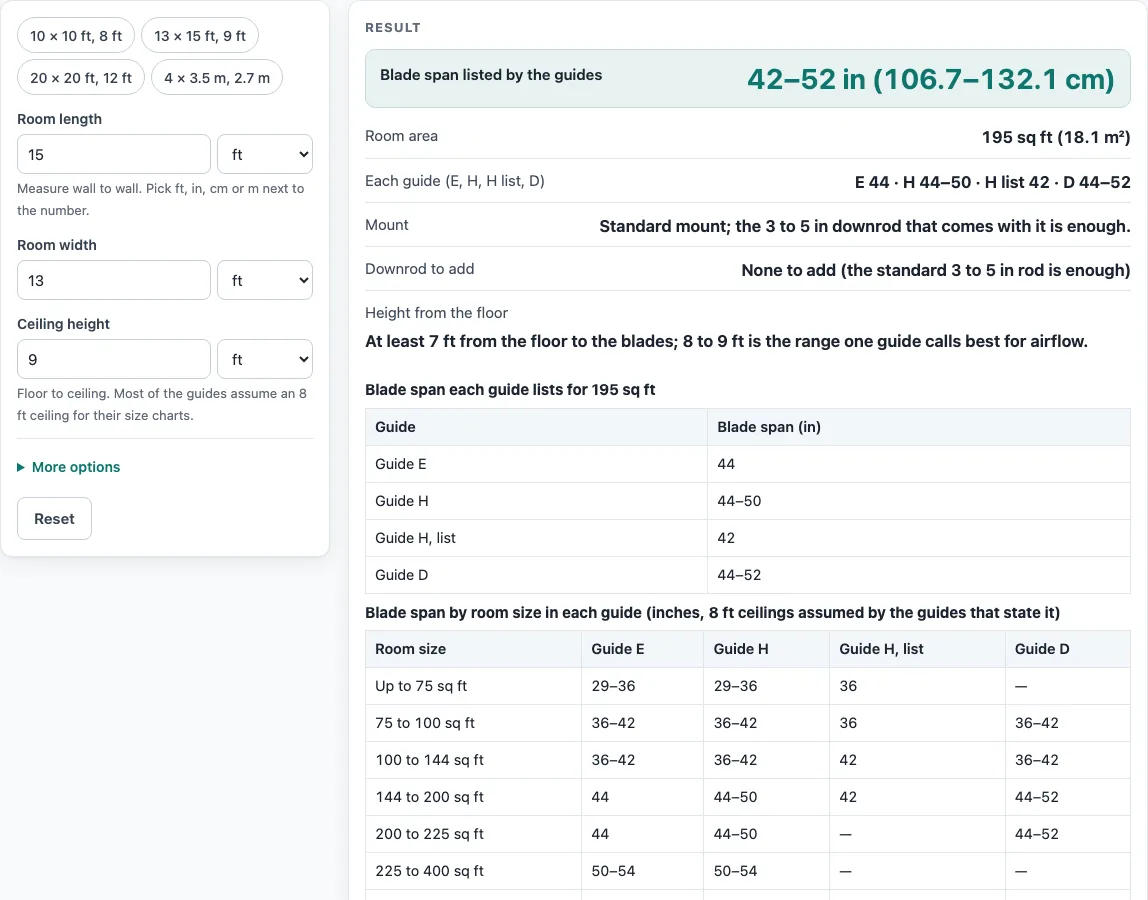
The blade span range is the lowest and highest blade span that any listed guide gives for your room area. It is never an average. The tool compares four sets of figures: a federal energy-efficiency programme’s ceiling fan page (E), a home-improvement publisher’s size chart (H), the same publisher’s second list (H list), and a DIY article that cites no source (D).
The room area is length × width. The tool works by area for any room shape, so it does not adjust for long, narrow rooms or open plans. The guides group areas into bands: up to 75, 75 to 100, 100 to 144, 144 to 200, 200 to 225, 225 to 400, and over 400 sq ft.
For a 15 × 13 ft room (195 sq ft), E gives 44 in, H gives 44–50 in, H list gives 42 in, and D gives 44–52 in. The range shown is 42–52 in (106.7–132.1 cm). Inches convert to centimetres at 1 in = 2.54 cm exactly.
The sources do not always agree. E and H agree on every band except 144–225 sq ft. The publisher’s second list (36 in up to 100 sq ft, 42 in up to 200 sq ft) conflicts with its own chart. D gives 44–52 in for 144–225 sq ft. All figures are shown, and none is averaged. The bands also share edges: 144 sq ft and, for E and H, 225 sq ft fall into two bands, so both figures are listed. Sizes vary by fan maker, so a guide figure is a typical size, not a rule for one model.
How is the downrod length calculated?
The downrod is the ceiling height minus the fan height minus the blade height above the floor. This is a fan maker’s formula. The defaults are a 12 in fan height, taken from the maker’s own example, and an 8 ft blade height.
With the default 9 ft ceiling, the ceiling is 108 in. The calculation is 108 − 12 − 96 = 0 in, so the standard rod in the box is enough.
In the second example, a 20 × 20 ft room (400 sq ft) with a 12 ft ceiling gives 144 − 12 − 96 = 36 in (91.4 cm).
A result of 5 in or less means the standard 3 to 5 in rod is enough. A rod over 120 in, or one between 5 and 6 in, triggers a warning. The tool also checks whether a standard rod would leave the blades under 7 ft. The guides give 7 ft as the lowest blade height and 8 to 9 ft as best for airflow. Another wording of the rule, which subtracts 8 feet from the ceiling height and then adds about 1 foot, gives a different number, so the tool does not use it.
Sources (checked 15 October 2026): energystar.gov · thisoldhouse.com · engineerfix.com · hunterfan.com
Worked examples
| Input | Result |
|---|---|
| Room 15 ft × 13 ft, ceiling 9 ft | blade span 42–52 in (106.7–132.1 cm); downrod: None to add (the standard 3 to 5 in rod is enough) |
| Room 10 ft × 10 ft, ceiling 8 ft | blade span 36–42 in (91.4–106.7 cm); downrod: None to add (the standard 3 to 5 in rod is enough) |
| Room 20 ft × 20 ft, ceiling 12 ft | blade span 50–54 in (127–137.2 cm); downrod: 36 in (91.4 cm) downrod, then round to the next length the maker sells |
| Room 4 m × 3.5 m, ceiling 2.7 m | blade span 42–52 in (106.7–132.1 cm); downrod: None to add (the standard 3 to 5 in rod is enough) |
Calculated by the tool above; open it with the same values to see each step.
How this tool works and where the numbers come from
Room area = length x width. The blade span shown is the lowest and highest span that any listed guide gives for that area band (ENERGY STAR, a home-improvement size chart and others), never an average. Downrod length = ceiling height - fan height - blade height above the floor (defaults 12 in and 8 ft); guides give 7 ft as the lowest blade height and 8 to 9 ft as best for airflow.
Sources
- ENERGY STAR (U.S. EPA / DOE). Ceiling Fan Basics (suggested fan size by room area; mounting at least 7 ft above the floor, 3 to 5 in standard downrod)
- Hunter Fan Company. How to Measure a Ceiling Fan (keep blades at least 7 feet above the floor; downrod length)
- This Old House. How To Size a Ceiling Fan (room area to fan diameter chart)
Frequently asked questions
Is the ceiling fan size chart the same for every fan maker?
No. Sizes vary by maker, so the chart gives typical figures from the named sources. Check the blade span and rod length on the fan you pick.
What is the smallest ceiling fan size?
For rooms up to 75 sq ft, the smallest band, ENERGY STAR and the home-improvement publisher’s chart both give 29 to 36 in, and a fan maker’s guide gives the same for rooms under 75 sq ft. The publisher’s second list says 36 in fans for rooms up to 100 sq ft. Enter a small room above to see the range for its area.
Can I use the ceiling fan size calculator for a long, narrow room?
The tool works by area only, so it does not adjust for long, narrow rooms or open plans. Use the result as a starting point and compare it with the room’s shape before you choose a fan.
Why do the four sources show different numbers?
Each source sets its own figures. E and H agree on most bands, but they differ at 144–225 sq ft, and D gives a different range again. The tool shows every figure and does not average them, so you can see the spread.
What blade height should I plan for?
The guides give 7 ft as the lowest blade height and 8 to 9 ft as best for airflow. The tool warns when blades are planned below 7 ft. You can change the blade height under “More options”.
What does a downrod result of 0 in mean?
It means a ceiling of this height needs no extra rod, so the standard rod in the box is enough. Results of 5 in or less mean the same thing. Results over 120 in or between 5 and 6 in trigger a warning, so check those with the fan’s instructions.
Is this ceiling fan size guide free, and is my data uploaded?
Yes, the tool is free and needs no sign-up. It runs in your browser, and nothing you type is uploaded.
Related tools
- What Size Ceiling Fan for a 12x12 Room?: use this when your room is a 12 by 12 ft square and you want a fan-specific answer.
- Chandelier Size Calculator: use this to size a light fixture for a room rather than a fan.
- Chandelier Size over a Dining Table: use this when you are sizing a fixture to hang over a table.
- Chandelier Height above a Table: use this to check how far a hanging light should sit above a table.
- Pendant Light Height Above a Kitchen Island: use this to set the drop of pendant lights over an island.
- Recessed Lighting Spacing Calculator: use this to plan the spacing of recessed lights in a room.
- Lumens per Square Foot by Room: use this to compare how much light different rooms need.
- How Many Recessed Lights Do I Need?: use this to estimate a light count for a room.