Chandelier Size over a Dining Table
Enter the table width (or diameter) and length to get the chandelier diameter range and the widest fixture that leaves a gap to the table edge.
Recent
Your last 10 settings, saved only in this browser. Nothing is uploaded.
How to use the chandelier size over dining table tool
- Choose your units: in, ft, cm or m.
- Pick the “Table shape”: “Rectangle or oval” or “Round”. Oval tables are handled the same way as rectangles.
- Enter the “Table width (diameter if round)”. For a round table, enter the diameter.
- For a rectangle or oval, enter the “Table length”.
- Open “More options” and enter the “Gap to the table edge”, the distance between the fixture edge and the table edge. The default is 6 in.
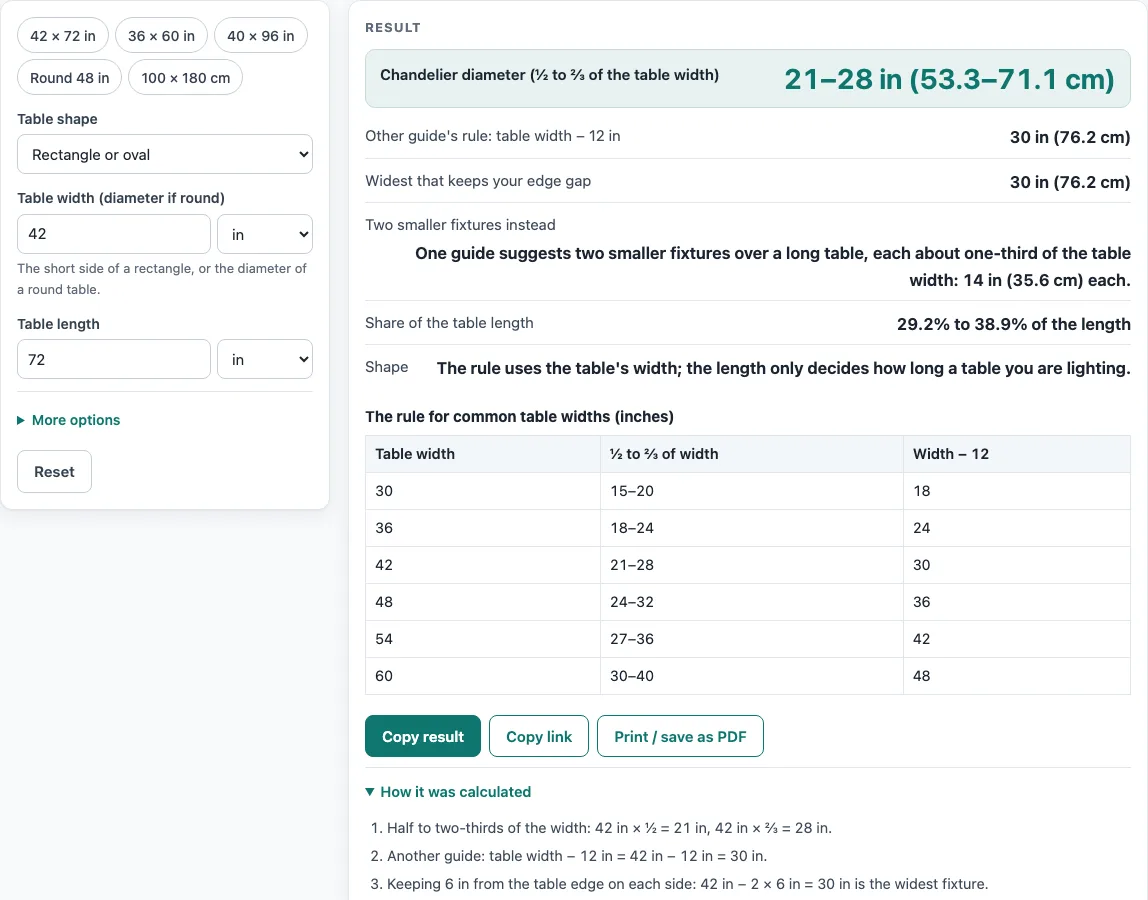
- Read the “Chandelier diameter” range. For a 42 × 72 in table with a 6 in gap, the result is 21–28 in.
- Read any warnings. A warning appears if the gap is under 6 in, if the two-thirds limit is wider than the edge limit, if no room is left, if the width is outside 20 to 120 in, or if the length is shorter than the width.
- For rectangles, check the “Share of the table length” line.
The page offers presets for quick checks: 42×72 in, 36×60 in, 40×96 in, round 48 in and 100×180 cm. Start with a preset, then change the numbers to match your table. For a round table the width is read as the diameter, so a 48 in round table gives 24–32 in. A table lists the rule for 30, 36, 42, 48, 54 and 60 in wide tables.
How big should a chandelier be over a dining table?
A common rule of thumb is a diameter between one-half and two-thirds of the table width. Three design guides state this range, and the tool uses it as its main result. For a 42 in wide table, the range is 21–28 in (53.3–71.1 cm).
How does the table width minus 12 in rule work?
A second guide suggests subtracting 12 in from the table width. For a 42 in table, that gives 30 in (76.2 cm). This number is the same as keeping 6 in of space from the table edge on each side, so the tool shows it as a single figure next to the range.
What is the edge gap, and why does it matter?
The widest fixture that keeps your edge gap is the table width minus twice the gap. With the 6 in default on a 42 in table, that is 42 − 12 = 30 in. One guide asks for at least 6 in between the fixture edge and the table edge, so the tool warns you when the gap you enter is under 6 in.
Here is a worked example. A 100 cm × 180 cm table is 39.37 in wide, so the range is 19.7–26.2 in (50–66.7 cm). If you enter a 15 cm edge gap, that is 5.9 in. It is under 6 in, so the tool shows a note.
When does the two-thirds limit go over the edge limit?
On a narrow table, two-thirds of the width can be wider than the widest fixture that keeps your edge gap. For example, on a 30 in table, two-thirds of the width is 20 in, but the edge limit is 18 in. The tool shows this conflict as a warning, so you can choose a smaller fixture or a smaller gap.
How is a round table measured?
For a round table, the guides’ “width” is read as the diameter. A 48 in round table gives a range of 24–32 in (61–81.3 cm). The page also has a table for 30, 36, 42, 48, 54 and 60 in wide tables. For 48 in, the table shows 24–32 in and a width minus 12 in figure of 36 in.
How do rectangular tables differ?
For a long rectangular table, one guide suggests two smaller fixtures, each about one-third of the table width. On a 42 in wide table, that is 14 in each. For rectangles, the tool also shows the range as a percentage of table length. On a 72 in table, the range is 29.2% to 38.9% of the length.
The tool does not calculate hanging height. For that, use the chandelier height above table page.
Sources (checked 15 October 2026): montreallighting.com · residencesupply.com · settingforfour.com
Worked examples
| Input | Result |
|---|---|
| Table 42 in wide, 72 in long | chandelier diameter 21–28 in (53.3–71.1 cm) |
| Round table, 48 in across | chandelier diameter 24–32 in (61–81.3 cm) |
| Table 40 in wide, 96 in long | chandelier diameter 20–26.7 in (50.8–67.7 cm) |
| Table 100 cm wide, 180 cm long | chandelier diameter 19.7–26.2 in (50–66.7 cm) |
Calculated by the tool above; open it with the same values to see each step.
Frequently asked questions
What size chandelier for a 42 inch wide dining table?
With the default 6 in edge gap, the diameter range is 21–28 in (53.3–71.1 cm). The width minus 12 in figure is 30 in (76.2 cm). Both numbers come from the rules of thumb on this page.
What happens if I enter an edge gap under 6 in?
The tool shows a note because one guide asks for at least 6 in between the fixture edge and the table edge. A smaller gap is allowed in your entry, but the result is a warning, not an approval.
Does an oval table use a different rule?
No. The page does not treat oval tables differently from rectangles, so enter the width and length in the same way.
Does this tool confirm that a size meets code?
No. The results are calculated from your inputs and from design rules of thumb. The tool does not check any building code, and it does not call any size correct or safe.
Why do chandelier sizes vary?
Sizes vary by maker, so a fixture that fits the range may still look different in a real room. Compare the fixture’s listed diameter with the range shown.
Does the tool calculate how high to hang the chandelier?
No. Hanging height is covered on the chandelier height above table page.
Related tools
- Chandelier Size Calculator: Use it when you want a general size estimate for a fixture in a different setting.
- Chandelier Height above a Table: Use it after you choose a size, to find the hanging height above the table.
- Ceiling Fan Size Guide: Use it when you are choosing a fan for the same room.
- What Size Ceiling Fan for a 12x12 Room?: Use it for a fan in a room of that exact size.
- How Many Recessed Lights Do I Need?: Use it when you are planning ceiling lights in addition to a fixture over the table.
- Lumens per Square Foot by Room: Use it to compare how much light a room needs.
- Pendant Light Height Above a Kitchen Island: Use it when you are hanging a pendant over an island rather than a dining table.
- Recessed Lighting Spacing Calculator: Use it to plan spacing for recessed lights around the room.