Curtain Size Calculator
Enter your window width, fullness, number of panels and rod height to get the fabric width per panel and the curtain length you need.
Recent
Your last 10 settings, saved only in this browser. Nothing is uploaded.
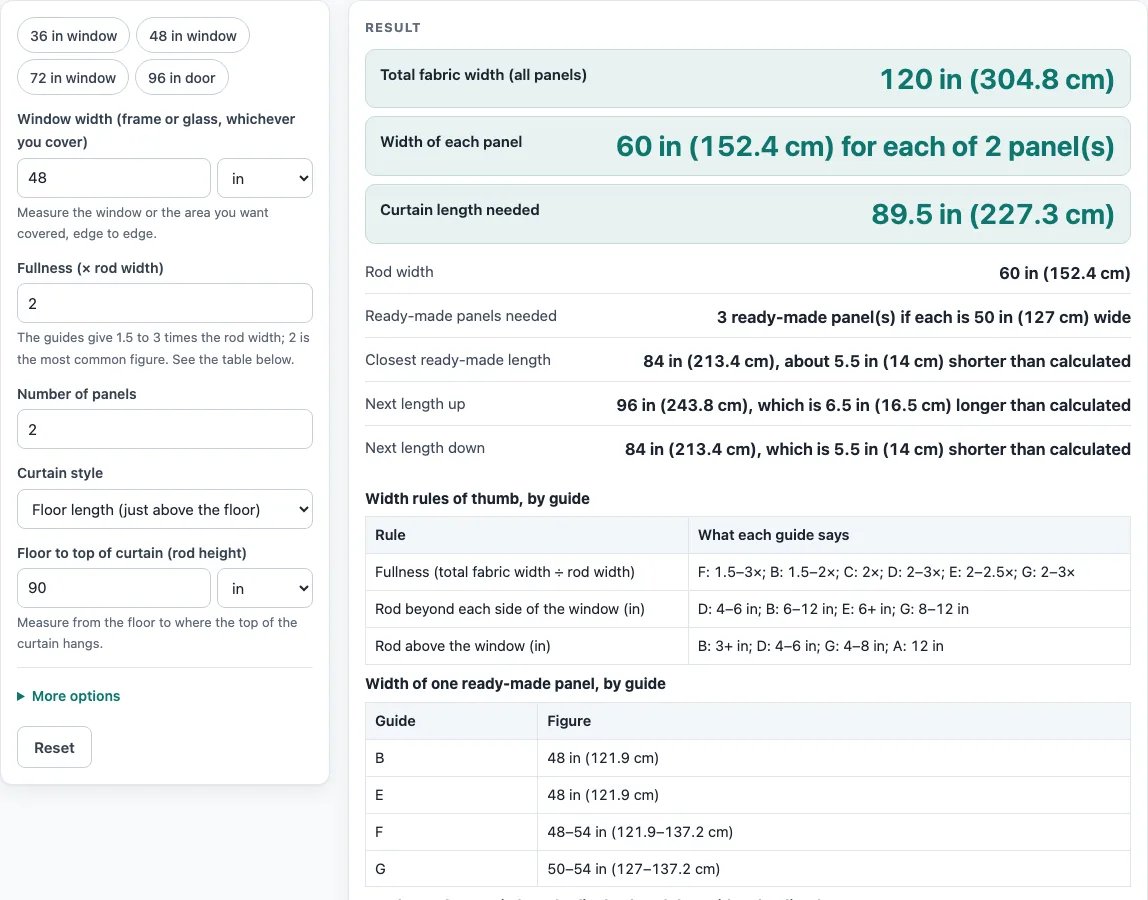
How to use the Curtain Size Calculator
- Each height and width field has its own unit selector: in, ft, cm or m.
- Enter “Window width”. The page warns if it is outside 12 to 240 in.
- Enter “Number of panels”. This must be a whole number from 1 to 20.
- Set “Fullness (× rod width)”. It starts at 2, which means total fabric width is twice the rod width. The page warns outside 1.5 to 3.
- Under more options, check “Rod beyond each side of the window” (6 in to start) and “Width of one ready-made panel” (50 in to start).
- Choose “Curtain style”: sill, apron, floor, trouser break or puddle.
- Enter “Floor to top of curtain (rod height)”. If you chose sill or apron, also enter “Floor to window sill”.
- Leave “Hem offset” blank for the default, or type your own in inches. The defaults are 1/2 in for sill and floor, 4 in for apron, 2 in for trouser break and 3 in for puddle.
- Read the results: “Rod width”, “Total fabric width (all panels)”, “Width of each panel”, “Ready-made panels needed”, “Curtain length needed”, “Closest ready-made length”, “Next length up” and “Next length down”.
Presets: a 36 in window, a 48 in window, a 72 in window (fullness 2.5) or a 96 in door. Errors stop a result from showing, such as a sill at or above the rod, or a missing or zero value. Warnings show a result but flag a value to check, such as fullness outside 1.5 to 3 or a panel wider than 120 in.
How is the fabric width for curtains worked out?
Total fabric width is the rod width multiplied by the fullness, and rod width is the window width plus twice the rod extension. Each panel then gets the total divided by the number of panels, and the number of ready-made panels is the total divided by one panel’s width, rounded up.
With the default inputs, a 48 in window and 6 in on each side give a rod width of 60 in. Fullness of 2 gives a total of 120 in (304.8 cm). Two panels means 60 in each, and with 50 in ready-made panels you need 3, because 120 ÷ 50 is 2.4, which rounds up to 3.
A second example uses a 72 in window with fullness 2.5 and the rod extended 6 in each side. The rod width is 84 in, the total fabric is 210 in, and two panels are 105 in each.
What fullness should curtains have?
Fullness is the total fabric width divided by the rod width. The guides give different ranges: 1.5 to 3 times the rod width (one guide, with 2 the most common), 1.5 to 2 times the window width (one guide), twice the window width (one guide), 2 to 3 times (two guides), and 2 to 2.5 times (one guide). The calculator starts at 2 and warns outside 1.5 to 3, so the value you choose depends on which guide you follow.
How much rod extension and panel width should I use?
Rod extension is how far the rod reaches beyond each side of the window. The guides list 4 to 6 in, 6 to 12 in, at least 6 in, and 8 to 12 in. Panel widths are listed as 48 in (two guides), 48 to 54 in, and 50 to 54 in. The calculator starts at 6 in for the extension and 50 in for the panel, and both can be changed to match the guide you use.
How long should curtains be?
The length needed depends on the style, and the hem offset is part of each formula. Floor length is the rod height minus the gap above the floor (the offset). Sill length is the rod height minus (sill height plus offset), and apron length is the rod height minus (sill height minus offset). Trouser break and puddle add the extra fabric to the rod height. The calculator then names the closest ready-made length from 63, 84, 96, 108 and 120 in, plus the next length up and down.
Five guides list 96 in, one lists 94 in and two list 95 in (one of those also lists 96). The calculator uses the ready-made lengths above, so a result of 95.5 in is shown with 96 in as the closest length, plus the next length up (96 in) and down (84 in).
Why do ceiling-height guides give different lengths?
The guides do not agree on the length for a ceiling height. One guide gives 96 in for an 8 ft ceiling and 108 or 120 in for 9 ft. Two others give 84 in for 8 ft and 96 in for 9 ft. The page shows each guide next to a length calculated from your own rod height, so you can see the gap for your room.
The same kind of disagreement happens with apron drop. One guide puts an apron about 4 in below the sill, and another about 1 in below the frame. The page starts at 4 in below the sill and shows both figures.
Sources (checked 15 October 2026): bobvila.com · amandakatherine.com · excitingwindows.com · linenchest.com · blog.kwikhang.com · engineerfix.com · dgfloors.com
Worked examples
| Input | Result |
|---|---|
| window 48 in, fullness 2, 2 panel(s) | total fabric 120 in, 60 in per panel, length 89.5 in |
| window 72 in, fullness 2.5, 2 panel(s) | total fabric 210 in, 105 in per panel, length 95.5 in |
| window 36 in, fullness 2, 1 panel(s) | total fabric 96 in, 96 in per panel, length 19.5 in |
| window 120 cm, fullness 2, 2 panel(s) | total fabric 118.1 in, 59.1 in per panel, length 90.1 in |
Calculated by the tool above; open it with the same values to see each step.
Frequently asked questions
Does the curtain size calculator work in feet or centimetres?
Yes. You can type heights and widths in in, ft, cm or m. Each field has its own unit selector.
What does the fullness warning mean?
It appears when the fullness is outside 1.5 to 3. The result still shows, but the value is outside the range the page flags. Check the fullness you have chosen against the guide you are following.
What are standard curtain sizes, and why is the closest length not an exact match?
The standard curtain sizes in the calculator are the ready-made lengths of 63, 84, 96, 108 and 120 in, and a ready-made panel width that starts at 50 in and that you can change. No building code or standard sets curtain sizes, so these are typical sizes. The calculator names the closest length, along with the next length up and down, so you can choose the one that fits your plan.
Does the calculator check a building code?
No. Results are calculated from your inputs and the guides’ typical figures. No building code or standard sets curtain sizes, so each guide keeps its own figures.
How do I choose the number of panels?
Enter a whole number from 1 to 20. The result tells you the width of each panel and how many ready-made panels you need, so you can compare options.
Do I need to sign up or install anything?
No. The calculator runs in your browser, it is free, and nothing you type is uploaded.
Related tools
- Curtain Length for 8 Foot Ceilings: use this when your ceiling is 8 ft and you want to compare lengths for that height.
- Curtain Length for 9 Foot Ceilings: use this when your ceiling is 9 ft and you want to compare lengths for that height.
- Curtain Length Guide: use this to read about curtain lengths in more detail before you enter your figures.
- Curtain Width Calculator: use this when you only need the width of fabric and panels.
- Standard Shower Curtain Width and Size Chart: use this when you need sizes for a shower curtain instead of a window curtain.