Dresser Dimensions and Fit Calculator
Enter the space, wall width and height limit to see the deepest, widest and highest dresser and which kinds of dresser fit.
Recent
Your last 10 settings, saved only in this browser. Nothing is uploaded.
This tool shows the dresser dimensions that suit a space. Enter the distance from the wall to the furniture the dresser faces, the wall width and the highest the dresser can be, and it returns the deepest, widest and highest dresser that will fit, along with which kinds of dresser fit and typical sizes for a standard dresser, a chest and a dresser’s drawers.
Use it before you shop so you know which dresser size will work in the spot where it will stand. Results are calculated from your inputs and typical sizes from two furniture retailers’ guides, which are kept apart in the results. Dresser sizes vary by maker, so check the listed dimensions of any specific dresser you are considering.
Everything runs in your browser, and nothing you type is uploaded.
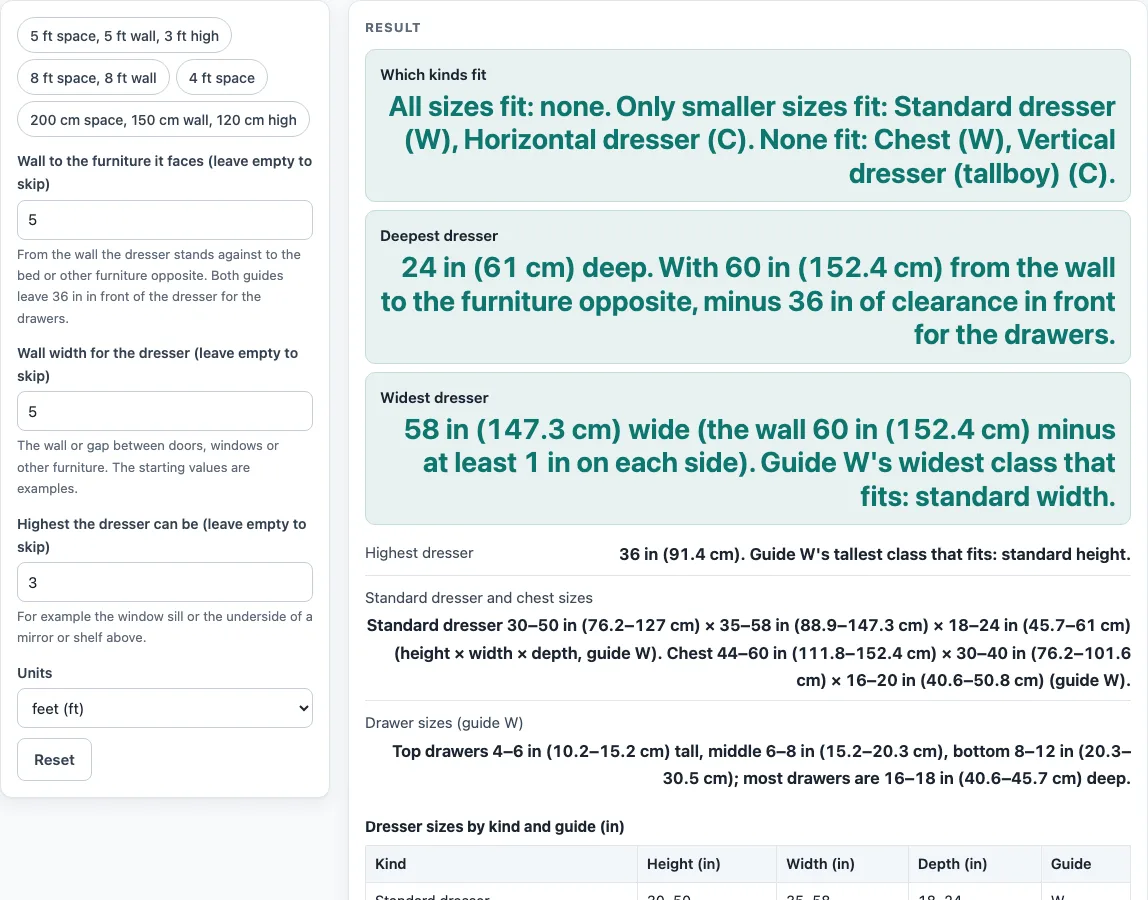
How to use the Dresser Dimensions Calculator
- Open the calculator. It starts with 5 ft for the space, 5 ft for the wall and 3 ft for the height.
- In “Wall to the furniture it faces (leave empty to skip)”, type the distance from the wall to the furniture the dresser faces, usually a bed.
- In “Wall width for the dresser (leave empty to skip)”, type the width of the wall where the dresser will stand.
- In “Highest the dresser can be (leave empty to skip)”, type the tallest the dresser can be, such as the height of the window sill.
- In “Units”, choose feet, inches or centimeters. Type your numbers in the same unit.
- Read “Deepest dresser”, “Widest dresser” and “Highest dresser” for the largest size that fits each limit.
- Read “Which kinds fit” to see which of the four kinds of dresser fit your limits.
- Compare “Standard dresser and chest sizes” and “Drawer sizes (guide W)” with the dresser you have in mind.
- Check for a warning or an error. An error appears if a space, wall or height is zero or not a number.
You can click a preset button to load a ready-made set of values: “5 ft space, 5 ft wall, 3 ft high”, “8 ft space, 8 ft wall”, “4 ft space” or “200 cm space, 150 cm wall, 120 cm high”. Leave a box empty to skip that limit. If all three boxes are empty, the tool shows a warning.
How is the deepest dresser calculated?
The deepest dresser is the space minus 36 in. Both furniture guides say to leave at least 36 in of clearance in front of the dresser so the drawers can open, so that clearance comes out of the space you measure.
Guide W describes the space as the distance from the wall to the furniture the dresser faces, usually a bed. With 5 ft (60 in) from the wall to the bed, the deepest dresser is 24 in (60 minus 36). With only 4 ft (48 in), the deepest dresser is 12 in.
The widest dresser is calculated differently. Guide C says to leave at least an inch on each side, so the widest dresser is the wall width minus 2 in. A 5 ft (60 in) wall gives a widest dresser of 58 in.
The highest dresser is not calculated. It is the number you type, such as the height of the window sill.
How does the tool decide which kinds fit?
The tool checks each kind of dresser against your limits and sorts the four kinds into three groups. A kind fits when the top of its listed range is within your limit in every dimension you entered. A kind is listed as “Only smaller sizes fit” when only the low end of its range is within your limit. It is listed as “None fit” when even its smallest size is too big in some dimension.
Height is often the limit that rules out a kind. The chest in guide W is 44 in tall at its shortest, and the vertical dresser (tallboy) in guide C is 40 in tall at its shortest. With a 36 in height limit, neither fits. The standard dresser in guide W and the horizontal dresser in guide C fit only in smaller sizes at that limit.
Guide W also sorts widths into classes: narrow (under 38 in), standard (38 to 58 in), wide (over 58 in) and extra wide (over 64 in). Heights are sorted into low (under 36 in), standard (36 to 50 in) and tall (over 50 in). The tool names the widest and tallest class that fits your limits. A 58 in width reaches the standard class, and 60 in reaches the wide class.
The two guides do not agree on every size. Guide W gives a standard dresser a width of 35 to 58 in, while guide C allows up to 70 in for a horizontal dresser. The results show each size with its guide so you can see where they differ.
Sources (checked 19 October 2026): Wayfair, dresser dimensions guide · Coleman Furniture, dresser dimensions guide
Worked examples
| Input | Result |
|---|---|
| space 5, wall 5, height 3 (ft) | 0 kinds fit fully, 2 partly |
| space 8, wall 8, height – (ft) | 4 kinds fit fully, 0 partly |
| space 4, wall –, height – (ft) | 0 kinds fit fully, 0 partly |
| space 200, wall 150, height 120 (cm) | 0 kinds fit fully, 4 partly |
| space –, wall 4, height 5 (ft) | 2 kinds fit fully, 1 partly |
| space –, wall –, height – (ft) | sizes only |
Calculated by the tool above; open it with the same values to see each step.
Frequently asked questions
What is a standard dresser size?
Guide W lists a standard dresser as 30 to 50 in tall, 35 to 58 in wide and 18 to 24 in deep, with usually 6 to 9 drawers. The tool shows these typical sizes in “Standard dresser and chest sizes”. Check the listed size of the dresser you want to buy.
What dresser height should I look for?
The right dresser height depends on your limit. Type the tallest the dresser can be into “Highest the dresser can be (leave empty to skip)”, and the tool shows which kinds fit under that height. For example, with a 36 in limit, the chest and the vertical dresser do not fit.
Why does the tool say “None fit”?
“None fit” means even the smallest size of each kind is too big in at least one dimension. The most common cause is a short space. With 4 ft (48 in) from the wall to the furniture, the deepest dresser is only 12 in.
Are dresser sizes the same for every brand?
No. Sizes vary by maker, so the typical sizes here are only a guide. Always check the listed dimensions of a specific dresser before you buy.
Can I enter measurements in centimeters?
Yes. Choose centimeters in “Units”, then type your measurements in centimeters. You can also use the preset “200 cm space, 150 cm wall, 120 cm high”.
Related tools
- Nightstand Height: Use it to check the height of a nightstand next to your bed.
- TV Stand Size: Use it to find a TV stand that suits your wall and screen.
- Bathroom Mirror Size: Use it to size a mirror for a bathroom wall.
- Wall Art Size Guide: Use it to pick the right size of art for a wall.
- Sofa, Mirror and Wall Decor Sizes: Use it to plan sizes for a sofa, mirror and decor above furniture.