Folding Table Sizes, Seats and Tablecloths
Choose a folding table and enter your guest count to see its size, seats, how many tables you need, the floor it takes and the cloth that fits.
Recent
Your last 10 settings, saved only in this browser. Nothing is uploaded.
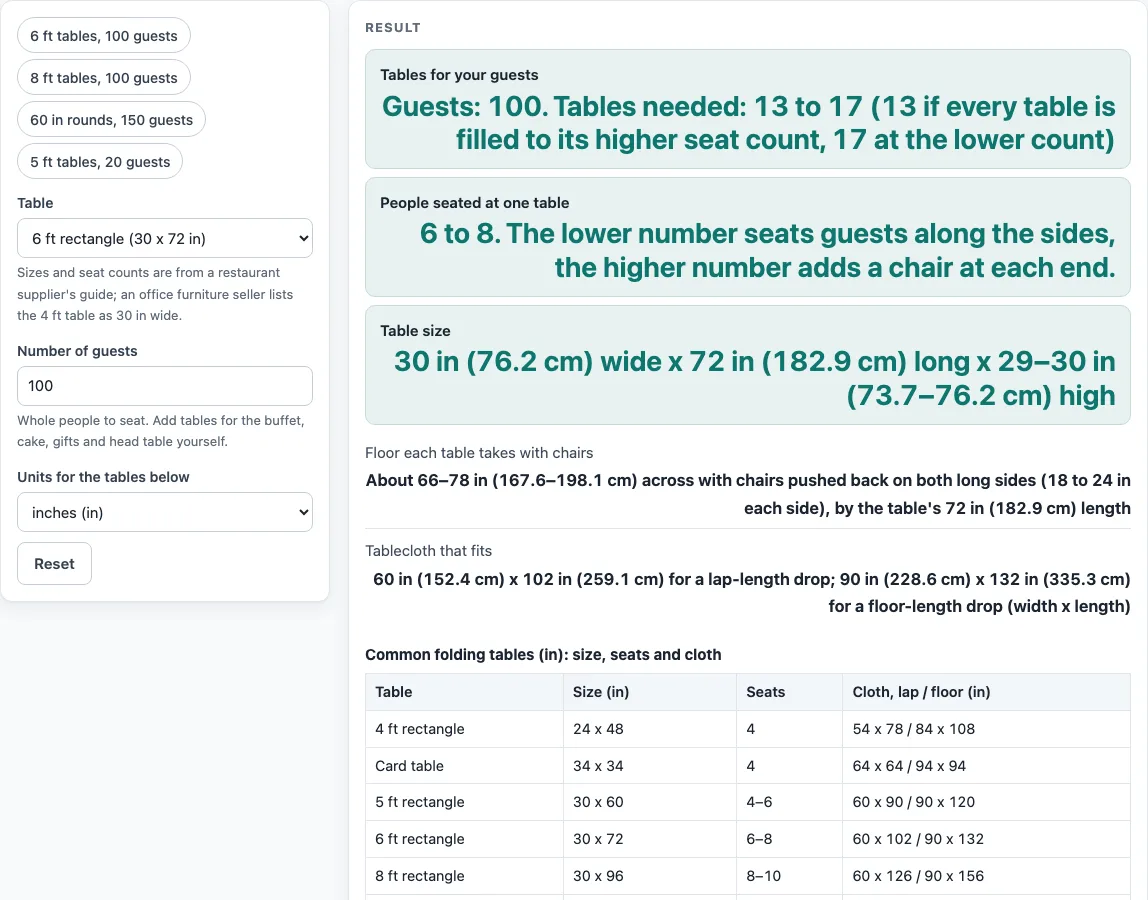
How to use the folding table size tool
- Open the “Table” control and choose your table type. The starting value is the 6 ft rectangle (30 x 72 in), so change it if you use a different table.
- Type your number of guests into “Number of guests”. Use a whole number above zero. The tool shows an error if the field is empty, not a number, zero, or not a whole number.
- Set “Units for the tables below” to inches or centimeters. The starting value is inches.
- Read “Tables for your guests.” It shows a range. The first number assumes every table is filled to its higher seat count, and the second assumes the lower count.
- Check “People seated at one table” to see how many guests each table seats.
- Check “Table size” to confirm the dimensions in your chosen units.
- Read “Floor each table takes with chairs” to plan the space each table needs with chairs pushed back.
- Read “Tablecloth that fits” to pick a cloth size for a lap-length or floor-length drop.
- Scroll to the chart under the results. It lists all eight tables with size, seats, and lap and floor cloth sizes in the unit you chose. A second table shows where the sources disagree.
The preset buttons fill in common setups in one click: “6 ft tables, 100 guests”, “8 ft tables, 100 guests”, “60 in rounds, 150 guests”, and “5 ft tables, 20 guests.” You can change any value after you press a preset. If you enter more than 2,000 guests, a warning appears above the results.
How many people fit at a folding table?
Each table has a seat range rather than one fixed seat count. The lower number seats guests comfortably along the sides, and the higher number adds a chair at each end. For example, a 6 ft table (30 x 72 in) seats 6 to 8 people, and a 60 in round seats 8.
Plan formal dinners at the lower number, where guests have more elbow room. Casual events can use the higher number to fit more people. The tool shows the seat range for each table in “People seated at one table,” so you can see both counts before you decide.
How many tables do I need for my guests?
The tool divides your guest count by the seats per table and rounds up. The result is shown as a range. The first number assumes every table is filled to its higher seat count, and the second assumes every table is filled to its lower count.
For 100 guests at 6 ft tables (6 to 8 seats), the calculation is 100 divided by 8 and 100 divided by 6, rounded up, which gives 13 to 17 tables. At 8 ft tables (8 to 10 seats), 100 guests need 10 to 13 tables. On 60 in rounds (8 seats), 100 guests need 13 tables. The tool counts guest tables only, so add a head table, buffet, cake table, or gift table yourself.
How much floor space does a folding table need?
The floor a table takes is more than its top. Guests need about 18 to 24 in of space behind their chairs on every seating side, so the tool adds that room to each side of the table.
For a 6 ft table (30 in wide, 72 in long), the width with chairs is 30 + 2 x 18 to 30 + 2 x 24, which is 66 to 78 in. The length stays at 72 in. A 60 in round needs 96 to 108 in across. The tool does not add aisles between tables. The supplier suggests 42 to 60 in of aisle, so plan for that space on top of each table’s footprint.
Sources (checked 19 October 2026): GoFoodservice, folding table sizes · OfficeFurniture2go, standard folding table sizes
Worked examples
| Input | Result |
|---|---|
| 6 ft rectangle, 100 guests | 13 to 17 tables |
| 8 ft rectangle, 100 guests | 10 to 13 tables |
| 60 in round, 150 guests | 19 tables |
| 5 ft rectangle, 20 guests | 4 to 5 tables |
| Card table, 9 guests | 3 tables |
| 48 in round, 1 guests | 1 tables |
Calculated by the tool above; open it with the same values to see each step.
Frequently asked questions
Why do sources give different sizes for the same table?
Makers and suppliers measure tables differently. An office furniture seller lists a 4 ft table as 30 x 48 in, while the restaurant supplier lists it as 24 x 48 in. Some 6 ft tables are 34 to 36 in wide instead of 30 in. The tool’s second table shows where sources disagree.
Is a 6 ft table always 30 in wide?
No. The restaurant supplier lists a 6 ft table as 30 x 72 in, and one plastic 30 x 72 x 29 in product is listed for 6 to 8 chairs. Some 6 ft tables are 34 to 36 in wide, so measure the table you will use before you plan.
How is the tablecloth size worked out?
The cloth size is the table size plus twice the drop on each dimension. A lap-length drop is about 15 in, and a floor-length drop is about 30 in. For example, a 30 x 72 in table takes a 60 x 102 in cloth with a lap drop, or a 90 x 132 in cloth with a floor drop.
Does the tool include the head table and buffet?
No. The tool counts only guest tables. A 150-guest wedding example from the supplier comes to about 24 tables once the head table, buffet, cake, and gifts are included. Add those tables to the result yourself.
Can I rely on these numbers for an official event plan?
The results are calculated from your inputs and typical sizes from the named sources. They are a planning aid, not a guarantee for a specific table. Check the dimensions and seat counts of the tables your rental company or maker provides before you finalize a plan.
Related tools
- Dining Table Size by Number of Seats: use this when you are choosing a permanent dining table for a set number of people.
- Round Table Sizes: use this to compare round table diameters and seating when round tables are your main choice.
- Picnic Table Dimensions: use this when you plan outdoor seating with a picnic table.
- Kitchen Island Size: use this when you are sizing an island for your kitchen.
- Tables and Seat Heights: use this to check that table and chair heights work together.