Murphy Bed Dimensions and Room Fit
Pick a mattress size and bed type, then enter your ceiling, wall and room to see the closed size, the open reach and whether the bed fits.
Recent
Your last 10 settings, saved only in this browser. Nothing is uploaded.
How to use the Murphy Bed Dimensions Tool
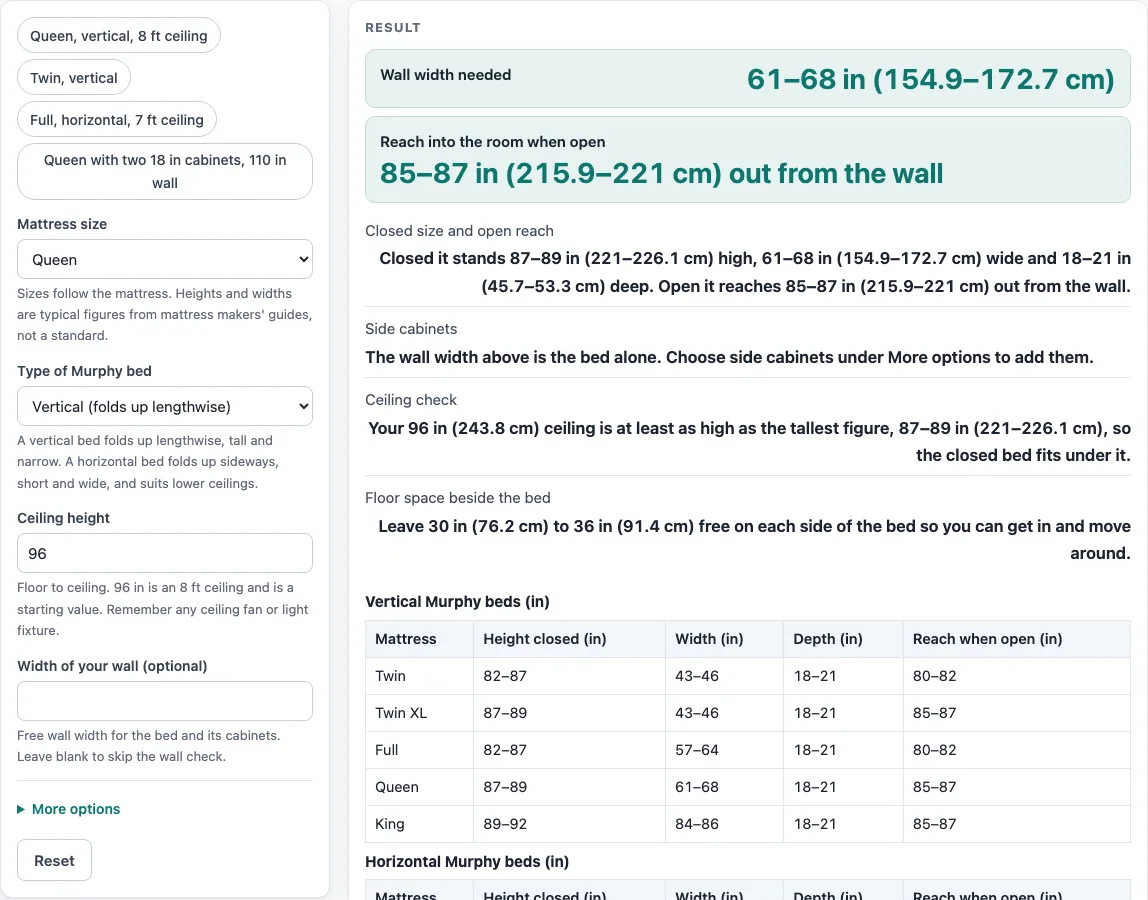
- Choose a Mattress size: Twin, Twin XL, Full, Queen or King. The tool starts on Queen.
- Pick a Type of Murphy bed: “Vertical (folds up lengthwise)” or “Horizontal (folds up sideways)”.
- Enter your Ceiling height. The starting value is 96 in.
- Enter the Width of your wall (optional) to check whether the wall is wide enough.
- Open More options if you want side cabinets. Choose Side cabinets (None, One side or Both sides) and a Width of each side cabinet of 18, 24 or 30 in.
- Type a Room depth, wall to the opposite wall (optional) to check how far the bed reaches into the room.
- Choose your Units.
- Read the outputs: “Closed size and open reach”, “Wall width needed”, “Ceiling check”, “Wall check” (when you entered a wall width), “Room depth check” (when you entered a room depth) and “Floor space beside the bed”.
- Scroll down to the two charts, one for vertical beds and one for horizontal beds. Use the legend for guides A, N, D and C.
The preset buttons fill in common setups for you: “Queen, vertical, 8 ft ceiling”, “Twin, vertical”, “Full, horizontal, 7 ft ceiling” and “Queen with two 18 in cabinets, 110 in wall”. If a field is empty, zero or not a number, the tool shows an error instead of a result.
How big is a Murphy bed when it is closed?
A closed Murphy bed is a box against the wall whose size depends on the mattress and the fold direction. A vertical twin is about 82 to 87 in high, 43 to 46 in wide and 18 to 21 in deep. A horizontal twin is shorter and wider, at about 45 to 48 in high and 80 to 85 in wide.
If you add side cabinets, the wall needs to be wider. The formula is:
Wall width needed = bed width + (number of cabinets × cabinet width)
For example, a vertical queen is 61 to 68 in wide. With two 18 in cabinets, the wall needs 61 + 36 = 97 in to 68 + 36 = 104 in.
How much space does a Murphy bed need when open?
When open, a bed reaches out from the wall by its “open reach”. A vertical queen reaches about 85 to 87 in, while a horizontal queen reaches about 65 to 68 in. Guides also advise leaving 30 to 36 in on each side of the bed so you can get in and move around. The “Room depth check” compares your room depth with the open reach.
What ceiling height do you need for a Murphy bed?
The safe ceiling height is at least the tallest closed height for your bed. For a vertical queen, that is 89 in. A ceiling inside the height range (87 to 89 in for that bed) may work, and a lower ceiling does not fit.
Horizontal beds suit lower ceilings. A horizontal queen is about 68 to 70 in high, and a horizontal full is only 62 to 64 in high.
What is the difference between a vertical and a horizontal Murphy bed?
A vertical bed folds up lengthwise, so it is tall and narrow and reaches further into the room when open. A horizontal bed folds up sideways, so it is short and wide, and you can enter it from one side only. Pick vertical if you have a tall ceiling and a narrower wall, and horizontal if your ceiling is low or your room is shallow.
How thick a mattress fits a Murphy bed?
Most Murphy beds are designed for mattresses about 12 in thick. Most mattresses are 9 to 12 in thick, so many will fit. Check the bed’s spec sheet for its exact maximum thickness before you buy a mattress. Foam mattresses (memory foam or latex) work best, because coil mattresses can bunch or slump when they stand upright.
Sources (checked 23 October 2026): amerisleep.com · nectarsleep.com · dreamcloudsleep.com · casper.com
Worked examples
| Input | Result |
|---|---|
| Queen, vertical | wall 61–68 in, reach 85–87 in |
| Queen, vertical | wall 97–104 in, reach 85–87 in |
| Full, horizontal | wall 80–85 in, reach 58–60 in |
| Twin, vertical | wall 43–46 in, reach 80–82 in |
| King, vertical | wall 114–116 in, reach 85–87 in |
Calculated by the tool above; open it with the same values to see each step.
Frequently asked questions
Are these measurements exact for every Murphy bed?
No. The figures are typical ranges from mattress makers’ guides, not an industry standard. Cabinets differ between makers, so check the spec sheet for your model before you build a wall or buy a bed.
Does a ceiling fan or chandelier affect the fit?
It can. Guides advise watching for ceiling fans and chandeliers when the bed is pulled down, since the bed swings into the space below.
Why does the queen width show as 61 to 68 in?
Makers differ on width. Two guides give a queen as 64 to 68 in wide, and a third gives 61 to 68 in. The tool shows the wider range so the check is safe for more models.
What are the side cabinets for?
Many Murphy beds come with cabinets on one or both sides of the bed, used for shelves, books, pictures or storage. The guides give widths of 18, 24 or 30 in, a depth of 16 in and a height about half an inch to an inch below the top of the closed bed. The tool adds their width to the wall you need.
What do the warnings about ceiling, wall and room sizes mean?
The tool warns if a ceiling is outside 72 to 144 in, or if a wall or room is outside 40 to 400 in. These limits catch typing mistakes, such as a number entered in the wrong units. Check the value and the units if you see a warning.
Related tools
- Bunk Bed Dimensions: Use this when you are sizing a bunk bed for a small room.
- Bed Height: Use this to check how high your bed sits from the floor.
- Rug Size for a Queen Bed: Use this to choose a rug that fits beside a queen bed.
- Rug Size for a King Bed: Use this to choose a rug that fits beside a king bed.
- Nightstand Height: Use this to match a nightstand’s height to your mattress.
- Dresser Dimensions and Fit Calculator: Use this to check whether a dresser fits along your wall.