Picture Hanging Height Calculator
Enter the picture height and the wire drop, then choose an open wall or furniture to get the nail height from the floor.
Recent
Your last 10 settings, saved only in this browser. Nothing is uploaded.
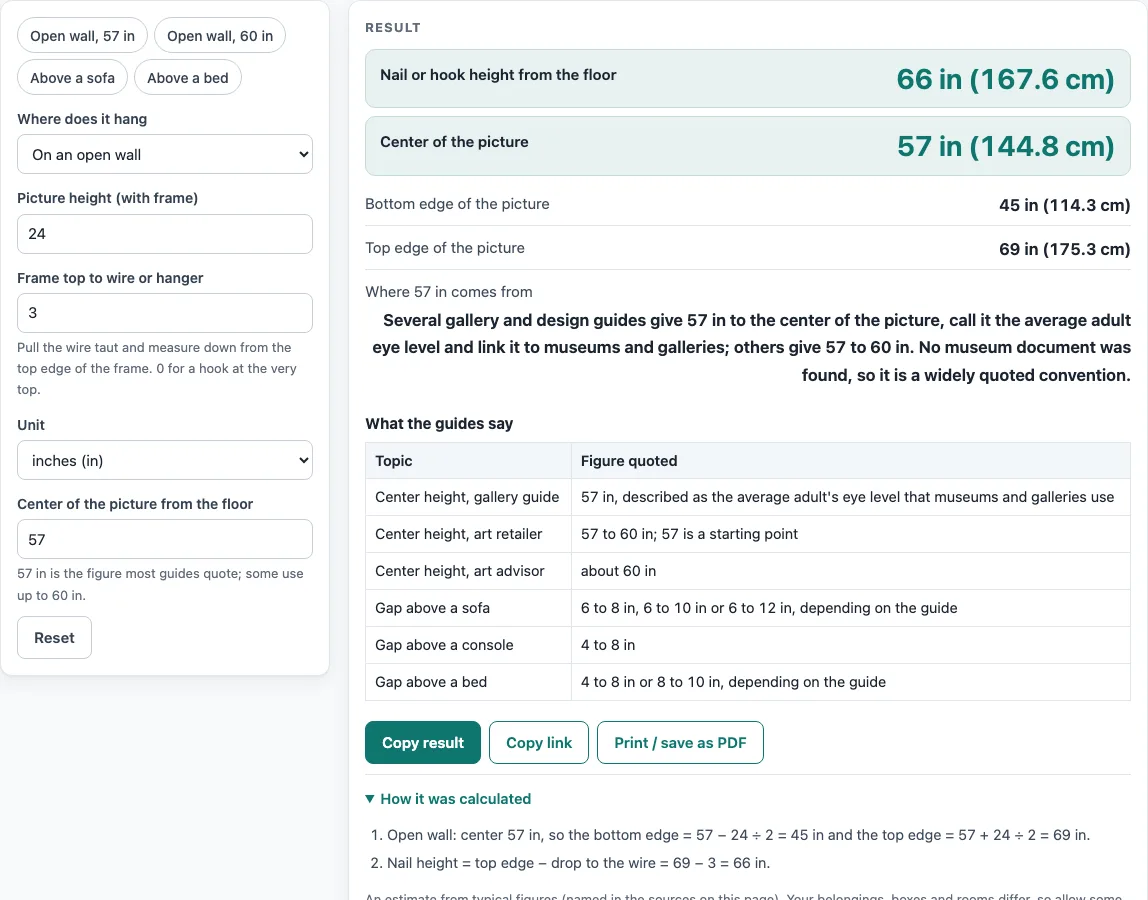
How to use the Picture Hanging Height tool
- Choose “Unit” as in or cm. Use the same unit for every measurement you enter.
- Under “Where does it hang”, select “On an open wall” or “Above furniture”. The fields below change to match your choice.
- Enter the “Picture height (with frame)”. The default is 24 in.
- Enter “Frame top to wire or hanger”. The default is 3 in. Measure with the picture face down, from the top edge of the frame to the wire or hanger.
- For an open wall, enter the “Center of the picture from the floor”. The default is 57 in.
- For above furniture, choose “Furniture below” (Sofa, Console or sideboard, Bed or headboard), then enter “Height of the furniture top” (default 36 in) and “Gap from furniture to the picture” (default 8 in).
- Read the results: “Nail or hook height from the floor”, “Center of the picture”, “Bottom edge of the picture” and “Top edge of the picture”.
- Check any warnings. They appear when a center is outside 57-60 in, a gap is above 12 in or outside the guide range for the furniture, the bottom edge is below the floor, the picture height is outside 2-120 in, or the top is above 144 in. Warnings compare your inputs with the ranges in the guides.
- If an error appears, fix the field it names. Errors cover blank, non-numeric, zero or negative heights or centers, negative drops or gaps, and a drop larger than the picture.
What is the standard picture hanging height on an open wall?
The most common starting point is a center height of 57 inches from the floor. Many guides describe this as average adult eye level, and they link it to museums and galleries, but no museum document was found, so the page treats it as a convention. Other guides give 57 to 60 inches, and one art advisor gives about 60 inches. The tool keeps the center height as an input and warns when it falls outside 57-60 inches. Sizes vary by guide, so treat these figures as starting points rather than fixed rules.
How is picture hanging height calculated?
The tool finds the edges of the picture first, then subtracts the drop. The bottom edge is the center minus half the picture height. The top edge is the center plus half the picture height. The nail height is the top edge minus the drop to the wire. With the defaults, a 24 inch picture centered at 57 inches has its bottom edge at 45 inches and its top edge at 69 inches, so the nail goes at 66 inches (167.6 cm). In metric, a 145 cm center with a 60 cm picture and an 8 cm drop puts the nail at 167 cm. One gallery guide prints a hook formula with a sign error, so the tool follows the maths of that guide’s worked example (center + half the height − drop).
How far above furniture should a picture hang?
Above furniture, the bottom edge sits at the furniture height plus the gap. The center is half the picture height above that bottom edge, and the nail sits the drop below the top edge. Guides differ on the gap. For a sofa, they give 6 to 8 inches (two guides), 6 to 10 inches, and 6 to 12 inches. For a console, they give 4 to 8 inches. For a bed, they give 4 to 8 inches or 8 to 10 inches. One guide says never more than 12 inches, which is why the tool warns above that figure. As a worked example, a 30 inch picture with a 4 inch drop above a 36 inch sofa with an 8 inch gap has its bottom edge at 44 inches, its center at 59 inches, its top edge at 74 inches, and its nail at 70 inches.
Sources (checked 15 October 2026): austingallery.org · passion4art.com · mixtiles.com · livingetc.com
Worked examples
| Input | Result |
|---|---|
| 24 in picture, On an open wall | nail at 66 in (167.6 cm) |
| 30 in picture, Above furniture | nail at 70 in (177.8 cm) |
| 20 in picture, Above furniture | nail at 56 in (142.2 cm) |
| 60 cm picture, On an open wall | nail at 65.7 in (167 cm) |
Calculated by the tool above; open it with the same values to see each step.
Frequently asked questions
Can I use centimeters instead of inches?
Yes. Set “Unit” to cm and enter every measurement in centimeters. Results are shown in both inches and centimeters, but the warning messages state their ranges in inches.
What does the drop mean?
The drop is the distance from the top of the frame to the wire or hanger. It moves the nail down from the top edge. Setting the drop to 0 puts the nail at the very top edge of the picture. A drop larger than the picture height causes an error.
Why does the tool show a warning?
A warning means your input is outside the ranges that the guides give, such as a center below 57 inches or a gap above 12 inches. It does not tell you that a result is wrong. You can still use the nail height the tool calculates from your numbers.
Does the tool upload my measurements?
No. The tool runs in your browser, nothing is uploaded, and you do not need to sign up. It is free to use.
Why do the guides give different numbers?
Guides disagree on the center height, which ranges from 57 to 60 inches in different sources. They also disagree on the gap above sofas, consoles and beds. The tool shows these differences in its table so you can compare them.
What picture sizes can I enter?
The tool warns when the picture height is outside 2 to 120 inches, and when the top edge goes above 144 inches. Blank, zero or negative heights are rejected with an error.
Related tools
- Bathroom Mirror Size for Your Vanity: Use this when you are choosing a mirror to fit above a bathroom vanity.
- Standard Sofa Dimensions: Use this when you need sofa sizes to plan the wall space above a sofa.
- TV Stand Size Calculator: Use this when you are sizing a stand for a TV and the wall above it.
- Wall Art Size Guide: Use this when you are picking the size of a piece of wall art for a space.