Rug Size for a Queen Bed
Set how much rug you want beside and past the bed, and pick whether it goes under the whole bed or the lower two-thirds. You get the standard rug sizes that work and the margin each one leaves.
Recent
Your last 10 settings, saved only in this browser. Nothing is uploaded.
How to use the rug size tool
- Enter the bed width and length. The tool starts at 60 x 80 in, the size of a US queen mattress. Pick your unit (in, ft, cm or m) first if you measured in another unit.
- Choose the rug placement: under the whole bed, or under the lower two-thirds of the bed.
- Open “More options” and set the rug beyond each side. It starts at 18 in.
- In the same section, set the rug past the foot. It starts at 24 in.
- Set whether the head of the bed is against a wall. It starts at yes.
- Read the results. Each standard size shows the inches of rug beyond each side and past the foot, and the table shows which direction the rug is laid. Any size that leaves smaller gaps than you set is marked “Gaps smaller than asked”.
Change the starting gaps to match the rule of thumb you are following. The tool gives a warning if the side gap is under 18 in, if the bed is outside 30-100 in wide or 60-100 in long, or if no standard size gives the gaps you set. Results are calculated from your inputs, so a change to any value updates the table.
How big should a rug be for a queen bed?
Start with the bed width and add the side gap twice. For a queen bed at the starting values, that is 60 + 2 x 18 = 96 in wide. For length, use the full bed length or two-thirds of it, then add the gap past the foot. Whole bed gives 80 + 24 = 104 in, and lower two-thirds gives 80 x 2/3 = 53.3, plus 24, for 77.3 in.
The gaps come from rules of thumb, and guides disagree. Some suggest 18-24 in or more beside the bed, others at least 18 in, and others 24-30 in. For the gap past the foot, guides say about 24 in or 24-30 in. The tool starts at 18 in and 24 in, which are the low ends of those ranges. One guide gives 84 in as the minimum width for a queen bed rug in one place and 96 in in its FAQ. These are retailer buying guides, not a standard, so pick the gaps that suit your room.
Should the rug go under the whole bed or only the lower two-thirds?
The two placements turn the rug in different ways. Under the lower two-thirds, the rug is first tried with its long side across the bed. Under the whole bed, the short side goes across the bed first. One guide places the rug perpendicular to the bed, so the table’s direction column is the place to check.
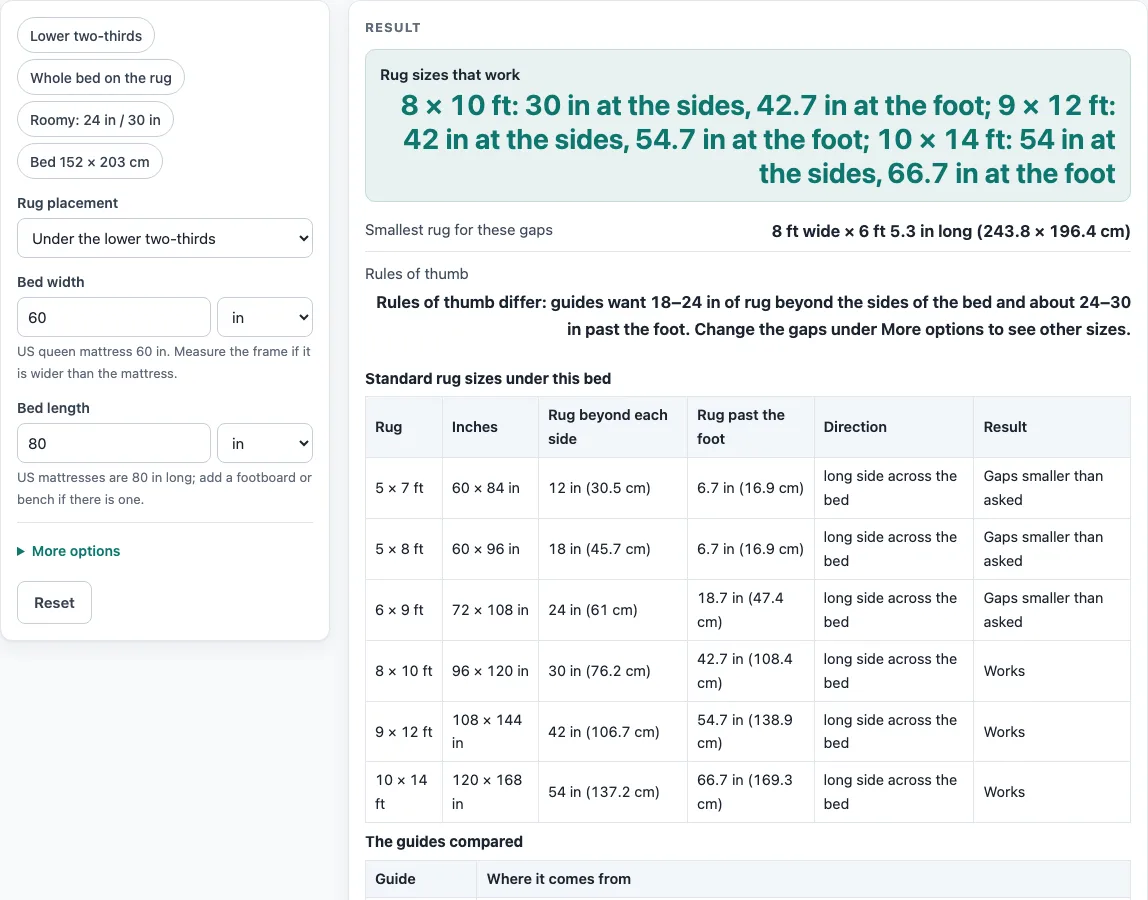
At the starting gaps, an 8 x 10 ft rug works under the lower two-thirds with 30 in at the sides and 42.7 in at the foot. A 9 x 12 ft rug gives 42 in and 54.7 in, and a 10 x 14 ft rug gives 54 in and 66.7 in. A 6 x 9 ft rug turned gives 24 in at the sides but only 18.7 in at the foot, so it falls short of the 24 in foot gap.
Under the whole bed, the rug must be at least 96 x 104 in. An 8 x 10 ft rug with its short side across the bed works with exactly 18 in at the sides and 40 in at the foot. A 6 x 9 ft rug with its short side across leaves 6 in at each side and 28 in past the foot, which is below the 18 in side gap, so the tool marks it “Gaps smaller than asked”.
A 5 x 7 ft rug is 60 x 84 in, so it leaves 0 in at the sides. That is why one guide does not recommend it under a queen bed. The tool shows it as fitting only when the gaps are set to 0.
Sources (checked 15 October 2026): atlantadesignerrugs.com · chairish.com · tumbleliving.com · bassettfurniture.com · amerisleep.com · atlantadesignerrugs.com
Worked examples
| Input | Result |
|---|---|
| 60 × 80 in bed, 18 in at the sides, 24 in at the foot, Under the lower two-thirds | works: 8 × 10 ft, 9 × 12 ft, 10 × 14 ft |
| 60 × 80 in bed, 18 in at the sides, 24 in at the foot, Under the whole bed | works: 8 × 10 ft, 9 × 12 ft, 10 × 14 ft |
| 60 × 80 in bed, 24 in at the sides, 30 in at the foot, Under the lower two-thirds | works: 8 × 10 ft, 9 × 12 ft, 10 × 14 ft |
| 59.8 × 79.9 in bed, 18.1 in at the sides, 24 in at the foot, Under the lower two-thirds | works: 8 × 10 ft, 9 × 12 ft, 10 × 14 ft |
Calculated by the tool above; open it with the same values to see each step.
Frequently asked questions
What is the smallest rug that works for a queen bed?
At the starting gaps, the smallest tested size that works is 8 x 10 ft. It works under the lower two-thirds and under the whole bed with the short side across. The tool shows the exact gaps for each placement.
Is a 5 x 7 rug big enough for a queen bed?
A 5 x 7 ft rug is 60 x 84 in, which leaves 0 in at each side of a queen bed. One guide does not recommend it, and the tool only shows it as fitting when the side gap is set to 0.
Can I use a 6 x 9 rug under a queen bed?
It depends on placement. Turned, it gives 24 in at the sides but 18.7 in past the foot. With the whole bed on it, it leaves 6 in at each side, which is below the 18 in starting gap.
Why do the guides give different numbers?
The guides are retailer buying guides, and they disagree on the gaps. Mattress sizes also vary by about an inch between makers, and a frame or headboard is wider than the mattress.
Does the bed frame change the result?
It can. If your frame or headboard is wider than the mattress, enter the width you actually need in the bed width input, and the length in the bed length input.
Can I enter measurements in metric?
Yes. You can enter the bed width and length in cm or m as well as in or ft. The tool calculates from the values you type, and nothing is uploaded.
Related tools
- Bedroom Area Rug Size: Use it when you are choosing a rug for the whole bedroom rather than just under the bed.
- Living Room Rug Size: Use it when you are sizing a rug for a sofa and seating area.
- Rug Size Chart: Use it to compare common rug sizes side by side.
- Rug Size for a Dining Table: Use it when the rug needs to sit under a table and chairs.
- Rug Size for a King Bed: Use it if your bed is a king rather than a queen.