Standard Shower Curtain Width and Size Chart
Enter the width of your tub or stall and the rod height to see the minimum curtain width and which standard shower curtain sizes are wide and tall enough.
Recent
Your last 10 settings, saved only in this browser. Nothing is uploaded.
How to use the Shower Curtain Size Tool
- Choose your “Opening”: “Bathtub with shower”, “Shower stall” or “Walk-in shower”.
- Enter the “Width of the tub, stall or rod (use the larger)”. If the rod is wider than the tub or stall, use the larger width.
- Enter the value in inches, feet, centimetres or metres. You can type in any of these units.
- Enter “Floor to rod (rod height)”, measured from the floor up to where the rod sits.
- Open more options and check the “Extra width for overlap and folds”. It starts at 12 inches.
- Read the “Minimum curtain width”. This is your width plus the extra width.
- Read “Narrowest sizes wide and tall enough”. It is the narrowest chart width that is at least your minimum and tall enough for your rod.
- Scan the table. Each size shows Yes, No or Depends on the guide under “Wide enough” and “Tall enough”. “Drop” shows how long the curtain can hang.
- Read any warning. Widths must be 20 to 120 inches and rod heights 48 to 120 inches. Missing or zero values, or a negative extra width, will show an error.
To try the tool quickly, load a preset: tub 60 in, stall 36 in (rod 78 in), walk-in 60 in (rod 90 in), or tub 152 cm (rod 190 cm). The default is a 60 inch tub with the rod at 75 inches and an extra width of 12 inches.
What is a standard shower curtain width?
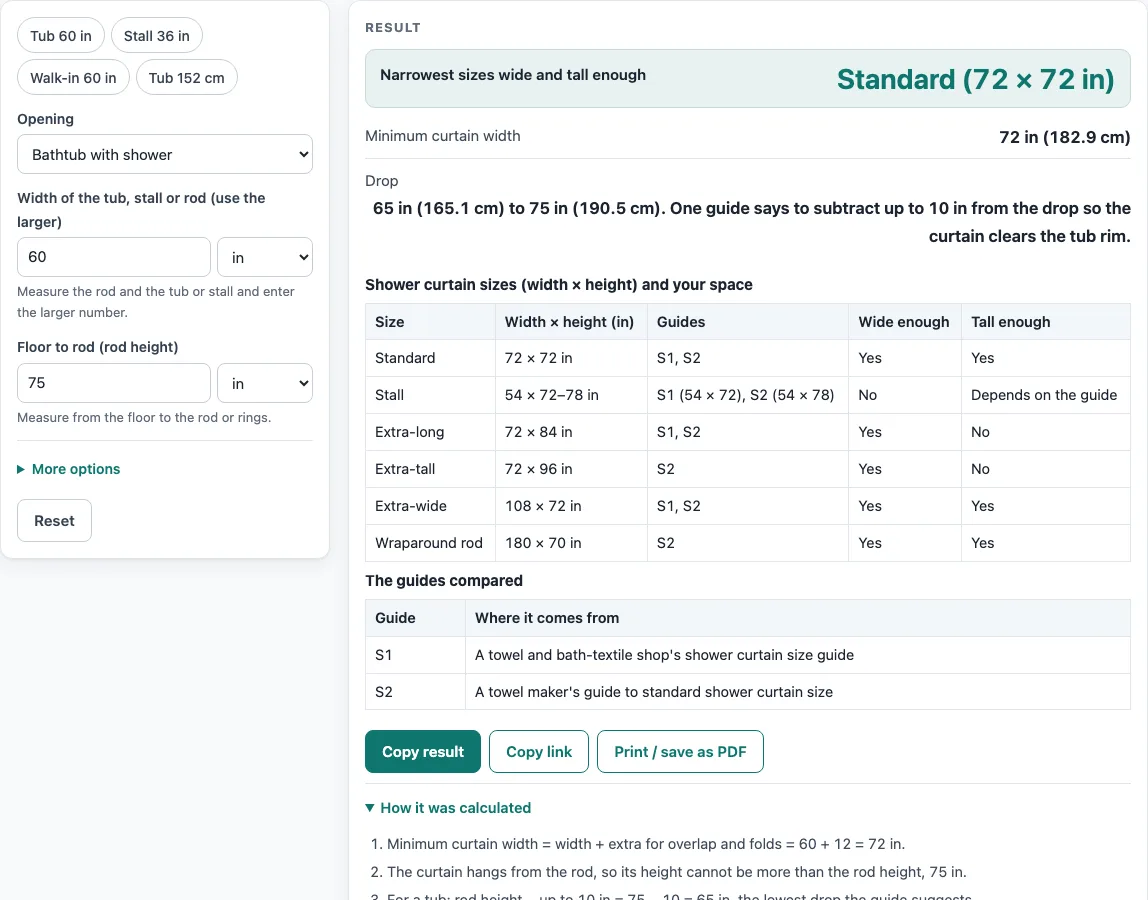
The standard shower curtain width in the typical sizes from the named sources is 72 inches, shown as 72 × 72 inches. Both guides list this size, but S2 notes that 72 × 72 is common rather than an industry standard, so treat it as a common starting point.
The chart on this page lists six sizes: standard 72 × 72, stall 54 × 72 to 78, extra-long 72 × 84, extra-tall 72 × 96, extra-wide 108 × 72 and wraparound-rod 180 × 70. Neither guide gives liner dimensions, and sizes vary by maker, so check the label on the curtain.
How is the minimum curtain width calculated?
The minimum curtain width is the width of your opening plus the extra width you enter. For a straight rod, one guide adds 12 inches for overlap and folds, and for a walk-in opening it asks for at least 12 inches more than the opening.
Take a 60 inch tub with the default extra width of 12 inches. That needs 72 inches (182.9 cm), so the standard 72 × 72 size is the narrowest match. A 36 inch stall with the rod at 78 inches and the same extra width needs 48 inches, so the narrowest chart width is 54 inches, and the stall size fits.
A 60 inch walk-in with the rod at 90 inches also needs 72 inches. The standard 72 × 72 and extra-long 72 × 84 both fit, but the 72 × 96 is too tall for that rod.
Why does the rod height matter for a shower curtain?
A size counts as tall enough when its height is not above your rod height. This is why the 72 × 96 size is ruled out when the rod is at 90 inches. If the rod height for a stall falls between the two guides’ values, the table marks height as “Depends on the guide”.
For a bathtub, S2 says to subtract up to 10 inches from the rod drop so the curtain clears the tub rim. The page therefore gives a range of the rod height minus 10 inches up to the rod height. With the default rod at 75 inches, that range is 65 to 75 inches. For a stall, S1 says to keep the curtain slightly above the floor, but it gives no inch figure, so the page gives none either.
Why do the guides give different stall and walk-in sizes?
The two guides disagree on the stall size. S1 lists 54 × 72, while S2 lists 54 × 78 for a 36 inch opening. The page shows 54 × 72 to 78 rather than choosing one, so the height may depend on the guide you follow.
S2 also gives 72 × 84 two different uses: a stall in its table and a walk-in in its text. The page lists 72 × 84 as extra-long only. Only S2 lists 72 × 96 and 180 × 70. Both guides list 72 × 72, 72 × 84 and 108 × 72.
A wider size also covers the width. The guides suit the extra-wide 108 × 72 for larger tubs and clawfoot tubs on a straight rod, so the page lists the narrowest matching size and tells you that a wider one may also work. The wraparound-rod 180 × 70 is skipped when the page names the result.
Sources (checked 15 October 2026): beanproducts.com · onsentowel.com
Worked examples
| Input | Result |
|---|---|
| Bathtub with shower, 60 in wide | minimum width 72 in; fits: Standard |
| Shower stall, 36 in wide | minimum width 48 in; fits: Stall |
| Walk-in shower, 60 in wide | minimum width 72 in; fits: Standard, Extra-long |
| Bathtub with shower, 152 cm wide | minimum width 71.8 in; fits: Standard |
Calculated by the tool above; open it with the same values to see each step.
Frequently asked questions
Why does the tool show “Depends on the guide”?
That label appears when the two guides give different answers for the same case. The usual reason is a stall with a rod height between 72 and 78 inches, because S1 and S2 list different stall heights.
Does the tool give liner sizes?
No. Neither guide lists liner dimensions, and sizes vary by maker. Check the product details for the liner you are considering.
What happens if my width is outside the allowed range?
The tool shows a warning. Widths must be between 20 and 120 inches, and rod heights must be between 48 and 120 inches. A warning also appears when no chart width reaches your minimum, apart from the wraparound size.
Why does the tool say no size is both wide and tall enough?
That message means no chart size reaches your minimum width and also stays within your rod height. Check your rod height and extra width first, since these two values drive the result.
Can I enter measurements in metric units?
Yes. Values can be typed in inches, feet, centimetres or metres. For example, the 72 inch minimum width from the default example is shown as 182.9 cm.
Is the result a code check or a safety approval?
No. The result is calculated from your inputs and typical sizes from the named sources. It is not a code check or a safety approval.
Will a clawfoot tub fit the extra-wide size?
The guides suit the extra-wide 108 × 72 for larger tubs and clawfoot tubs on a straight rod. The tool lists the narrowest matching size, so check whether the extra-wide size is the one you need.
Related tools
- Curtain Length for 8 Foot Ceilings: Use this when you need curtain length for a room with 8 foot ceilings.
- Curtain Length for 9 Foot Ceilings: Use this when you need curtain length for a room with 9 foot ceilings.
- Curtain Length Guide: Use this to compare curtain length options in general.
- Curtain Size Calculator: Use this to work out the size of a curtain for a window or room.
- Curtain Width Calculator: Use this when you need to find the width of a curtain.