Standard Table Height by Table Type
Pick a table type to see its standard height from the floor, the seat or sofa height that goes with it, and the knee space to leave.
Recent
Your last 10 settings, saved only in this browser. Nothing is uploaded.
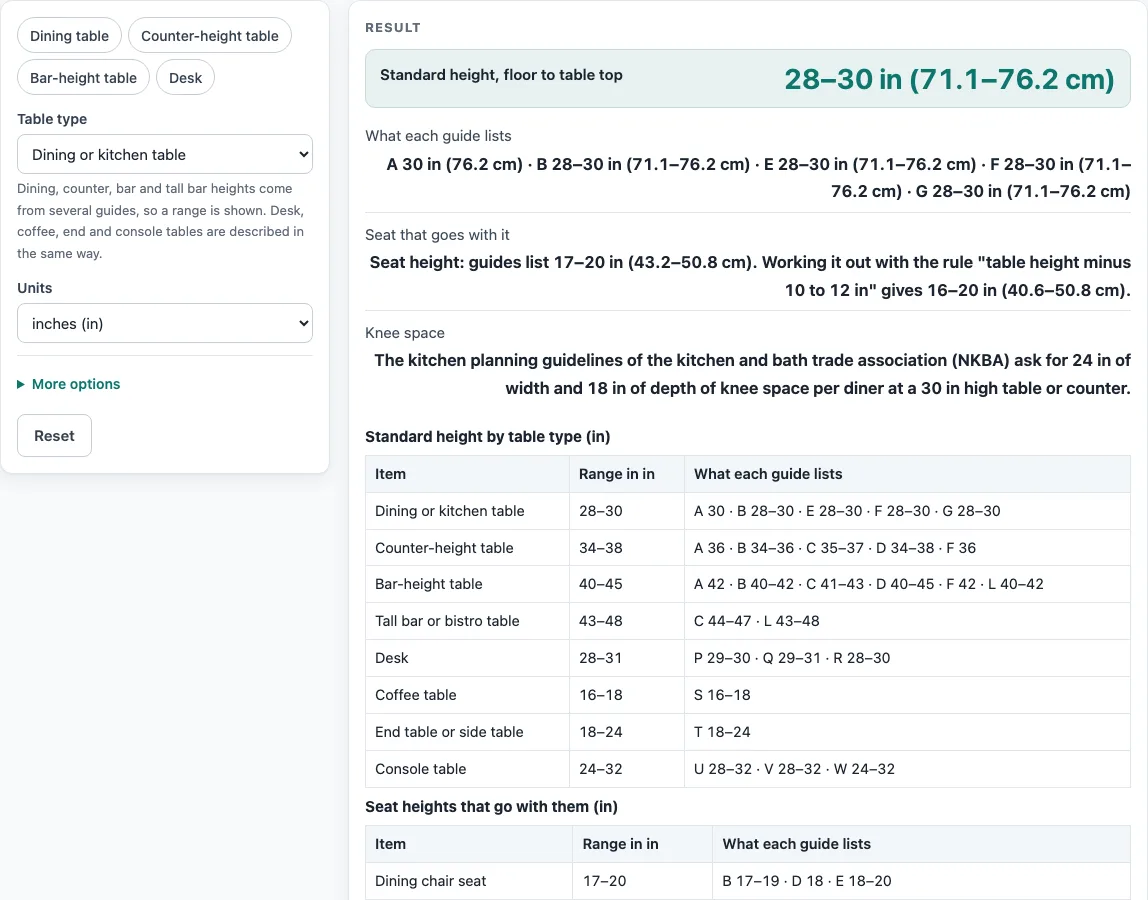
How to use the Standard Table Height Tool
- Open the “Table type” menu and choose the table you are planning or measuring, such as “Dining or kitchen table,” “Counter-height table,” or “Desk.”
- Set “Units” to inches or centimeters.
- Read “Standard height, floor to table top.” This is the usual range for that table type. The low and high ends come from the lowest and highest figure any guide gives.
- Read “Seat that goes with it” to see the matching seat or sofa height.
- For dining, counter-height, and bar-height tables, read “Knee space” to see the depth needed under the top.
- Optional: under “More options,” type your table’s height into “Height of your table (optional).” The “What your height matches” output then lists every table type whose usual range includes that number.
- Scroll down to the charts for heights by table type and seat heights, plus two legends of guides.
The preset buttons, “Dining table,” “Counter-height table,” “Bar-height table,” and “Desk,” load that table type in one click. The tool needs a table type. If nothing is picked, or the optional height is zero, negative or not a number, it shows an error. It also shows a warning for any height outside 10 to 60 in.
What is the standard height of a dining table?
A standard dining or kitchen table is 28 to 30 in (71.1 to 76.2 cm) from the floor to the table top. One kitchen planning guideline gives 30 in exactly. These figures are the usual range for dining tables, not a fixed rule.
The chair seat should sit below the table by a set gap. The common rule is to subtract 10 to 12 in from the table height. For a 28 to 30 in table, that gives 16 to 20 in (28 minus 12 is 16, and 30 minus 10 is 20). The dining chair seats in the guides, 17 to 20 in, fall inside that result. The tool’s knee space figure for a dining table comes from the kitchen and bath trade association’s (NKBA) kitchen planning guidelines, guideline 9. At a 30 in high table, those guidelines call for 18 in of depth under the top and 24 in of width per diner.
What is the difference between counter height and bar height?
Counter-height tables and counters are about 34 to 38 in tall, and they are used with stools of 24 to 27 in. Bar-height tables and bars are about 40 to 45 in tall, and they are used with stools of 28 to 33 in.
The same seat rule explains the stool ranges. Subtracting 10 to 12 in from a counter-height table gives 22 to 28 in, and from a bar-height table gives 28 to 35 in. The listed stools sit inside or near those results. Pub tables are a separate case: they are 40 to 42 in tall with stools of about 28 to 30 in, so they sit at the bar end of the range.
Knee depth also changes with height. The NKBA guidelines list 15 in of depth at a 36 in counter and 12 in at a 42 in counter or bar.
Sources (checked 15 and 23 October 2026): kb.nkba.org, kitchen planning guidelines · ashdeco.com, dining chairs · hunker.com, bar vs counter stool · livingspaces.com · giorgibros.com · bassettfurniture.com · hunker.com, dining table height · pooltableportfolio.com · autonomous.ai, desk height · rmi.colostate.edu · woodbin.com · ashdeco.com, coffee tables · chairish.com, end tables · flowyline.com, console tables · homestyler.com · ashdeco.com, console tables
Worked examples
| Input | Result |
|---|---|
| dining or kitchen table | usual height 28–30 in (71.1–76.2 cm) |
| counter-height table | usual height 34–38 in (86.4–96.5 cm) |
| bar-height table | usual height 40–45 in (101.6–114.3 cm) |
| coffee table | usual height 16–18 in (40.6–45.7 cm) |
| desk | usual height 28–31 in (71.1–78.7 cm) |
Calculated by the tool above; open it with the same values to see each step.
Frequently asked questions
What is the standard height of a coffee table?
A coffee table is 16 to 18 in tall. The usual rule is to set its top at the sofa seat height or 1 to 2 in lower.
What is the standard desk height?
The guides give 28 to 31 in, and the tool shows that range. There is no single chair height for a desk. Guides set desk height by your seated elbow height, and say the desk should be able to adjust at least 2 in below your seated elbow height. A university risk-management office says fixed desks at the standard 29 to 31 in are too high for about 95 percent of people.
How far below the table should the seat be?
The common rule is a gap of 10 to 12 in between the table top and the seat. To check your own setup, measure the seat height of your chair and compare it with the table height.
What does a table height of 33 in match?
It matches no table type. 33 in falls between the dining or kitchen range (28 to 30 in) and the counter-height range (34 to 38 in). A height of 36 in matches only the counter-height table, and 42 in matches only the bar-height table.
Why does the tool show a range instead of one number?
Each range runs from the lowest to the highest figure any guide gives. The tool shows each guide’s own figure and does not average them. This makes differences between guides easy to see.
Is the standard table height a building code?
No. These are guide figures, not a building code, and tables vary by maker. Check the actual dimensions of the table you plan to buy or use.
Related tools
- Counter Height vs Bar Height: use it when you are choosing between a counter and a bar for a kitchen or room.
- Bar Height Table Chart and Size Calculator: use it when you are sizing a bar-height table and want a chart.
- Dining Chair Height for Your Table: use it when you have a table and need to check the chair seat height.
- Standard Desk Height: use it when you are setting up a desk and want elbow-height guidance.
- Coffee Table Height: use it when you are choosing a coffee table to match a sofa.
- End Table Height: use it when you are matching a side table to a sofa or chair arm.
- Console Table Height: use it when you are placing a console table behind a sofa.
- Dining Table Size by Number of Seats: use it when you know how many people you need to seat.